Coreless Motors: How They Work, Benefits, Types, and Applications
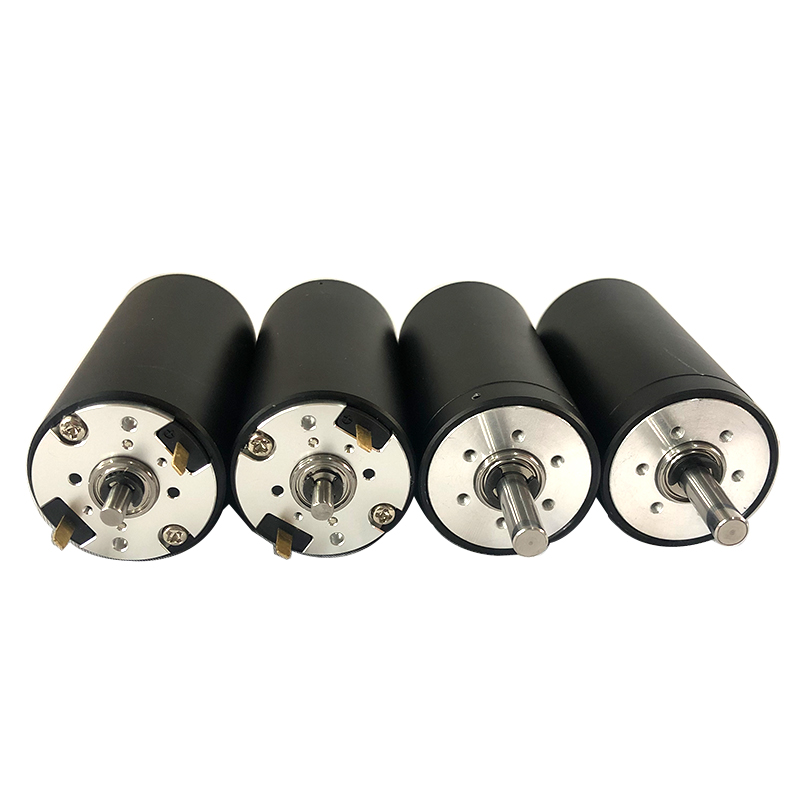
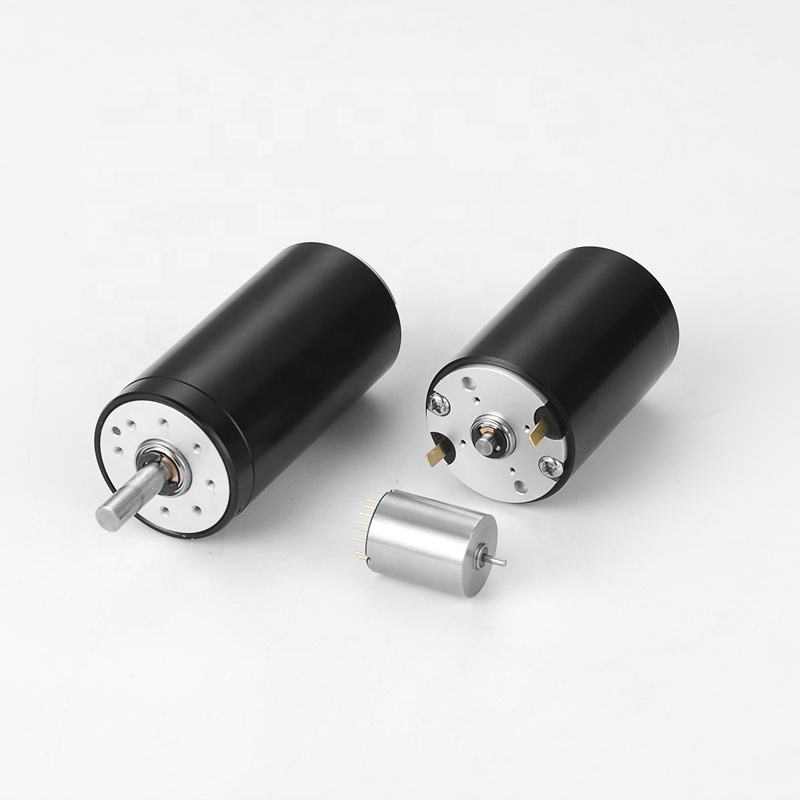
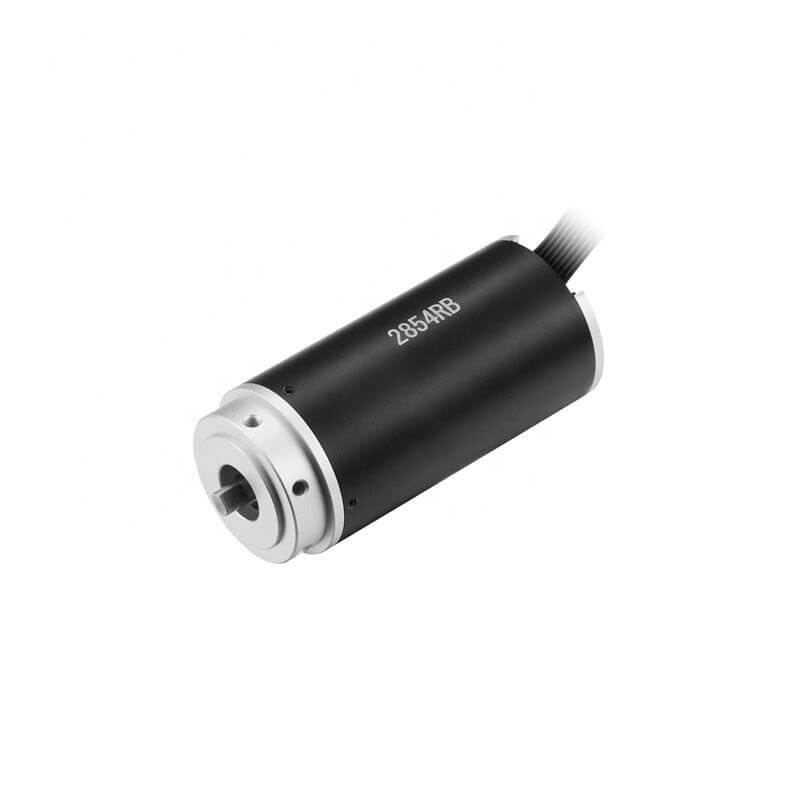
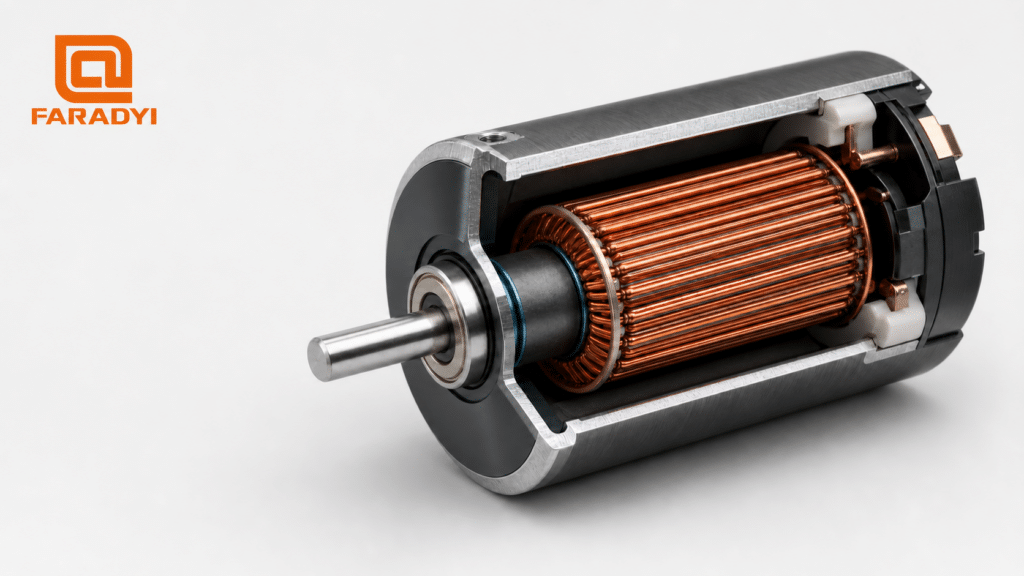
Coreless motors are compact electric motors designed without the laminated iron core found in a conventional motor rotor. Instead, they use a lightweight, self-supporting copper winding that rotates within a magnetic field.
This construction gives coreless motors low rotor inertia, smooth operation, rapid acceleration, and precise control. These characteristics make them suitable for robotics, medical equipment, optical systems, drones, portable tools, and other applications where size, response time, or motion quality matters.
In simple terms, a coreless motor is a strong option when an application requires fast starts and stops, low cogging, compact dimensions, or accurate motion. However, engineers must still consider torque, speed, voltage, heat dissipation, duty cycle, controller requirements, and service life before choosing a motor.
What Is a Coreless Motor?
A coreless motor, sometimes called an ironless motor, is a DC motor whose rotating winding does not contain a conventional iron core.
In many brushed coreless DC motors, copper wire is formed into a rigid cylindrical basket or bell and bonded with resin. A permanent magnet is positioned inside or around this winding, depending on the motor design.
Removing the iron rotor core changes the motor’s performance in several important ways:
- Rotor mass and moment of inertia are reduced.
- Iron losses in the rotor are eliminated.
- Cogging torque is greatly reduced.
- The rotor can accelerate and decelerate quickly.
- Low-speed rotation is smoother.
- Winding inductance is generally lower.
It is important to understand that “coreless” does not necessarily mean “brushless.” A motor can be both coreless and brushed, or it can use an ironless winding in a brushless design.
“Coreless” describes the motor’s winding or rotor construction. “Brushed” and “brushless” describe how the electrical current is switched to maintain rotation.
How Do Coreless Motors Work?
Like other permanent-magnet DC motors, coreless motors convert electrical energy into mechanical rotation through the interaction between electrical current and a magnetic field.
The operating process can be summarized in four steps:
- A power supply sends current through the motor windings.
- The energized winding produces an electromagnetic force within the permanent magnet’s field.
- This force generates torque, causing the rotor and output shaft to turn.
- The commutation system switches current through the appropriate windings so that continuous torque is produced in the same rotational direction.
In a brushed coreless DC motor, brushes and a commutator perform this electrical switching mechanically.
In a brushless coreless motor, an electronic controller switches current between the motor phases according to the rotor’s position.
Because there are no iron rotor teeth interacting with permanent magnets, a coreless motor produces very little cogging torque. This allows it to accelerate, decelerate, and reverse quickly while maintaining smooth rotation.
Main Components of a Coreless DC Motor
Self-Supporting Copper Winding
The winding is one of the defining parts of a coreless motor.
Copper wire is commonly formed into a skewed, honeycomb, or basket pattern and bonded with resin. In a brushed coreless motor, this lightweight winding acts as the rotating armature without requiring a heavy iron core.
The winding pattern must be mechanically strong enough to maintain its shape while rotating at high speed.
Permanent Magnet System
Permanent magnets create the fixed magnetic field required to generate torque.
Depending on the motor architecture, the magnet may be located inside the cylindrical winding or may form part of an external magnetic circuit around it.
The magnet material, size, and configuration affect the motor’s torque, speed, efficiency, temperature characteristics, and overall cost.
Shaft and Bearings
The shaft transfers the motor’s mechanical output to the application.
Bearings support the shaft and help control friction, noise, vibration, maximum speed, and service life. Motor selection should account for any radial and axial loads placed on the shaft.
Commutation System
A brushed coreless motor uses brushes and a commutator to switch current through the winding.
A brushless version uses electronic commutation. Depending on the control requirements, the system may use Hall sensors, an encoder, or sensorless control to determine the correct switching sequence.
Coreless Motors vs. Conventional Iron-Core Motors
The primary difference is the absence of an iron core in the rotating winding.
| Characteristic | محرك بدون قلب | Conventional Iron-Core DC Motor |
|---|---|---|
| Rotor construction | Self-supporting winding without an iron core | Copper winding around laminated iron |
| قصور الدوار | Low | Generally higher |
| Cogging torque | Very low | Present to varying degrees |
| Dynamic response | Fast | Generally slower |
| Low-speed smoothness | Excellent | Depends on the motor design |
| Rotor thermal capacity | Lower | Iron core can absorb more heat |
| Manufacturing cost | Usually higher | Often lower |
| Typical use | Compact, responsive, precision systems | General-purpose or cost-sensitive systems |
On smaller screens, swipe horizontally to view the complete comparison.
A coreless motor is not automatically superior in every application. Actual performance depends on motor dimensions, winding design, magnet material, bearings, controller, cooling method, load, and operating point.
Engineers should compare model-specific data instead of selecting a motor based only on its general category.
Advantages of Coreless Motors
Fast Acceleration and Deceleration
The lightweight rotor has a low moment of inertia. Therefore, less torque is needed to change the motor’s speed.
This enables rapid starts, stops, and direction changes. It is especially useful in scanning systems, robotic mechanisms, positioning equipment, and applications with frequent motion cycles.
Smooth, Low-Cogging Rotation
Conventional iron-core motors may experience cogging when the rotor’s iron teeth interact with the permanent magnets.
A coreless motor eliminates the iron rotor teeth, significantly reducing this effect. The result is smooth rotation with minimal torque variation.
This is valuable in applications such as:
- Precision pumps
- Camera mechanisms
- Optical instruments
- Positioning systems
- المعدات الطبية
- Low-vibration actuators
Compact Size and Low Weight
Removing the iron rotor core reduces the rotating mass and allows a compact motor structure.
Coreless motors can provide responsive performance within a small motor envelope, making them useful for portable devices, miniature mechanisms, and equipment with strict size or weight restrictions.
High Efficiency at the Correct Operating Point
Because the rotor has no iron core, it does not produce the same rotor iron losses found in conventional designs.
This can improve efficiency and extend the operating time of battery-powered devices. However, total system efficiency still depends on copper losses, bearings, brushes, electronic controls, gearing, and the motor’s actual operating point.
Rapid Torque Response
Coreless windings generally have low electrical inductance, allowing current to change quickly.
Because motor torque is related to winding current, this characteristic supports fast torque response and precise dynamic control.
However, low inductance can increase current ripple if the drive electronics and pulse-width modulation frequency are not properly matched to the motor.
Limitations of Coreless Motors
Coreless motors offer important performance benefits, but they also have design limitations.
Higher Manufacturing Cost
Coreless windings require specialized manufacturing methods. High-performance magnets and precision components may also increase the motor’s cost compared with a standard iron-core motor.
Thermal Sensitivity
The self-supporting winding has limited thermal mass and does not have an iron core to absorb heat.
Excessive current, prolonged overload, or a stalled shaft can increase winding temperature quickly. The motor’s continuous current, peak current, and thermal limits must be respected.
Limited Overload Duration
A coreless motor may provide high peak torque for a short time, but its continuous torque rating is lower than its temporary peak rating.
Peak and continuous specifications should never be treated as interchangeable.
Controller Requirements
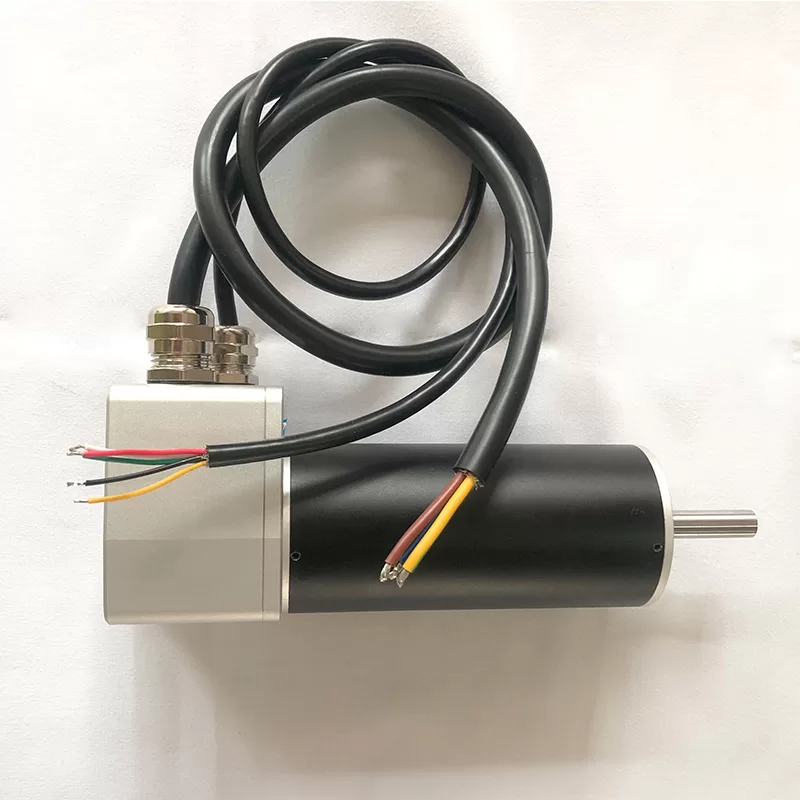
Brushless coreless motors require a compatible electronic controller.
The controller must match the motor’s voltage, current, phase configuration, sensors, and control requirements. Low-inductance motors may also require careful selection of current-control settings and PWM frequency.
Brush Wear in Brushed Models
Brushed coreless motors are easy to control, but their brushes and commutator experience mechanical wear.
The expected life depends on speed, current, duty cycle, temperature, brush material, and operating environment. A brushless motor may be more appropriate when long service life and minimal maintenance are priorities.
Brushed vs. Brushless Coreless Motors
Brushed Coreless Motors
Brushed coreless motors are relatively simple to operate from a DC supply. Their rotational direction can normally be reversed by changing the polarity.
They offer:
- Simple drive electronics
- Fast acceleration
- Compact dimensions
- Smooth rotation
- Responsive speed control
Brushed coreless motors are commonly considered for portable devices, miniature pumps, actuators, toys, personal-care equipment, and intermittent-duty mechanisms.
Their principal limitation is brush and commutator wear. Electrical noise and sparking may also be concerns in sensitive environments.
Brushless Coreless Motors
Brushless coreless motors use electronic commutation instead of mechanical brushes.
They generally offer:
- Longer service life
- Lower maintenance
- Reduced electrical noise
- Higher-speed capability
- Better suitability for continuous operation
However, they require a compatible motor driver. Applications needing accurate low-speed operation or positioning may also require Hall sensors or an encoder.
The added control complexity is often worthwhile in medical equipment, aerospace systems, robotics, industrial automation, and continuously operating devices.
Common Applications of Coreless Motors
Medical and Laboratory Equipment
Coreless motors can be used in compact pumps, analyzers, surgical tools, prosthetic mechanisms, and other equipment requiring controllable movement in a limited space.
Their smooth rotation can benefit applications where flow consistency or low vibration is important.
Medical-device suitability depends on the complete product design and validation process. Selecting a coreless motor alone does not establish regulatory compliance.
Robotics and Industrial Automation
Low rotor inertia allows a coreless motor to respond quickly to control commands.
Potential applications include:
- Robotic grippers
- Miniature actuators
- Mobile robots
- Inspection systems
- Precision positioning mechanisms
- Automated laboratory equipment
An encoder can provide position or speed feedback, while a gearbox can increase output torque when the load requires it.
Drones and Aerospace Systems
Low weight and fast response can benefit small airborne systems, actuators, control mechanisms, and other aerospace applications.
Engineers must verify the motor’s suitability for the platform’s vibration, altitude, temperature, reliability, and environmental requirements.
Optical and Imaging Equipment
Smooth rotation and low cogging make coreless motors useful in optical equipment where vibration can affect image quality.
Examples include:
- Autofocus mechanisms
- Lens positioning systems
- Camera stabilization
- Scanners
- Microscopes
- Precision imaging equipment
Portable Tools and Consumer Products
Coreless motors can help reduce the size and weight of battery-powered devices.
They may be used in portable tools, personal-care equipment, haptic devices, electronic locks, small pumps, and other compact consumer products.
Precision Pumps
The controllability of a coreless motor makes it suitable for compact pumping systems that need consistent speed or rapid flow adjustments.
Motor selection should account for the pump’s starting torque, pressure, operating speed, continuous duty, and expected temperature rise.
How to Select a Coreless Motor
Motor selection should begin with the application’s load and motion requirements—not only the desired motor diameter.
1. Define the Supply Voltage
Identify the available nominal voltage and its possible operating range.
Also confirm the voltage and current limits of the motor driver or power supply.
2. Calculate the Required Load Speed
Determine the required speed at the output shaft or driven load.
If a gearbox is used, include its reduction ratio and efficiency. Remember that no-load speed is not the same as the motor’s actual speed under load.
3. Determine Continuous and Peak Torque
Calculate the torque required to overcome:
- Load resistance
- Friction
- Acceleration
- Gearbox losses
- External forces
Separate the continuous torque requirement from short-duration peak torque.
4. Define the Duty Cycle
Determine how long the motor will run, rest, accelerate, reverse, or remain stalled during each operating cycle.
Frequent starts, rapid reversals, and long running periods can significantly affect winding temperature.
5. Check the Thermal Conditions
Evaluate:
- Ambient temperature
- Available airflow
- Motor mounting
- Housing contact
- Nearby heat sources
- Permitted winding temperature
- Continuous operating time
Thermal testing should be performed with the motor installed in the actual product whenever possible.
6. Choose Brushed or Brushless Operation
Choose a brushed model when simple electronics and lower system complexity are important.
Choose a brushless model when the application prioritizes longer service life, continuous operation, lower maintenance, or reduced electrical noise.
7. Evaluate Feedback and Gearing
Determine whether the application requires:
- Hall sensors
- An encoder
- Closed-loop speed control
- Position control
- A planetary gearbox
- Another reduction mechanism
High motor speed does not always mean high usable output torque. A properly selected gearbox can convert motor speed into additional output torque.
8. Review Mechanical Requirements
Confirm the allowed:
- Motor diameter
- Motor length
- Shaft diameter
- Shaft length
- Mounting interface
- Radial bearing load
- Axial bearing load
- Noise and vibration level
9. Test the Motor in the Final Application
Prototype testing should measure:
- Loaded speed
- Continuous current
- Starting current
- Winding or housing temperature
- Noise
- اهتزاز
- كفاءة
- Positioning performance
- Expected service life
Testing at the actual operating point is more reliable than making a decision from no-load specifications alone.
Information to Provide When Requesting a Motor Recommendation
To help a motor manufacturer identify an appropriate model, provide:
- Nominal and maximum supply voltage
- Target operating speed
- Continuous torque
- Peak torque and its duration
- Duty cycle
- Available motor diameter and length
- Shaft dimensions
- Brushed or brushless preference
- Encoder or Hall sensor requirements
- Gear ratio, if applicable
- Ambient temperature
- Expected annual order quantity
- Application and operating environment
Complete application information allows engineers to evaluate electrical, mechanical, and thermal requirements more accurately.
Explore Faradyi Coreless Motors
Faradyi Motor supplies brushed and brushless coreless motor options for compact, responsive, and precision-driven applications.
Motor configurations can be evaluated according to voltage, speed, torque, dimensions, gearing, feedback, shaft design, duty cycle, and other project requirements.
Explore Faradyi coreless motors or contact the Faradyi engineering team with your application parameters to request a motor recommendation and quotation.
Frequently Asked Questions About Coreless Motors
What does “coreless” mean in a motor?
Coreless means the rotating winding does not use the laminated iron core found in a conventional DC motor rotor. Instead, the winding is formed into a self-supporting cylindrical or flat structure.
Are coreless motors always brushless?
No. Coreless describes the motor’s internal construction, while brushed and brushless describe the commutation method. Both brushed and brushless coreless motor designs are available.
Why do coreless motors accelerate quickly?
Their lightweight rotor has a low moment of inertia. Less torque is therefore required to change the rotor’s speed, enabling fast starts, stops, and direction reversals.
Do coreless motors produce more torque?
Not automatically. Coreless motors can provide high torque relative to their size and respond quickly, but actual torque depends on the winding, motor dimensions, magnets, current, cooling, speed, and duty cycle.
The motor’s torque-speed curve and thermal limits should be checked before selection.
Are coreless motors more efficient?
Coreless motors eliminate rotor iron losses, which can improve efficiency at suitable operating points. Total efficiency still depends on copper losses, friction, commutation, electronic control, gearing, and load conditions.
Can a coreless motor run continuously?
Yes, provided it operates within its continuous current, torque, speed, and thermal limits.
Continuous operation should be verified inside the final assembly because mounting, airflow, ambient temperature, and nearby components affect heat dissipation.
Do coreless motors need a controller?
A brushed coreless DC motor can usually operate from a suitable DC supply, although a driver may be used for speed and current control.
A brushless coreless motor requires an electronic controller for commutation.
Can a coreless motor be combined with a gearbox?
Yes. A gearbox can reduce output speed and increase available output torque.
The selected gearbox must be compatible with the motor’s speed, torque, shaft, mounting interface, duty cycle, and expected service life.
When should I choose a coreless motor?
Consider a coreless motor when your application requires compact size, fast response, low inertia, smooth low-speed rotation, or minimal cogging.
A conventional iron-core motor may be more appropriate when the lowest possible cost, greater thermal mass, or extended overload capability is the main priority.
خاتمة
Coreless motors replace the conventional iron-core rotor with a lightweight, self-supporting winding. This structure reduces inertia and cogging torque, enabling smooth rotation, rapid acceleration, compact dimensions, and precise dynamic control.
These advantages make coreless motors valuable in robotics, medical equipment, optical systems, portable tools, drones, precision pumps, and other demanding applications.
However, successful motor selection requires more than choosing a motor type. Voltage, loaded speed, continuous torque, peak torque, duty cycle, temperature, controller requirements, gearing, feedback, and mechanical dimensions must all be evaluated together.
To discuss your application, view the Faradyi coreless motor range and send the engineering team your operating specifications for a customized recommendation.