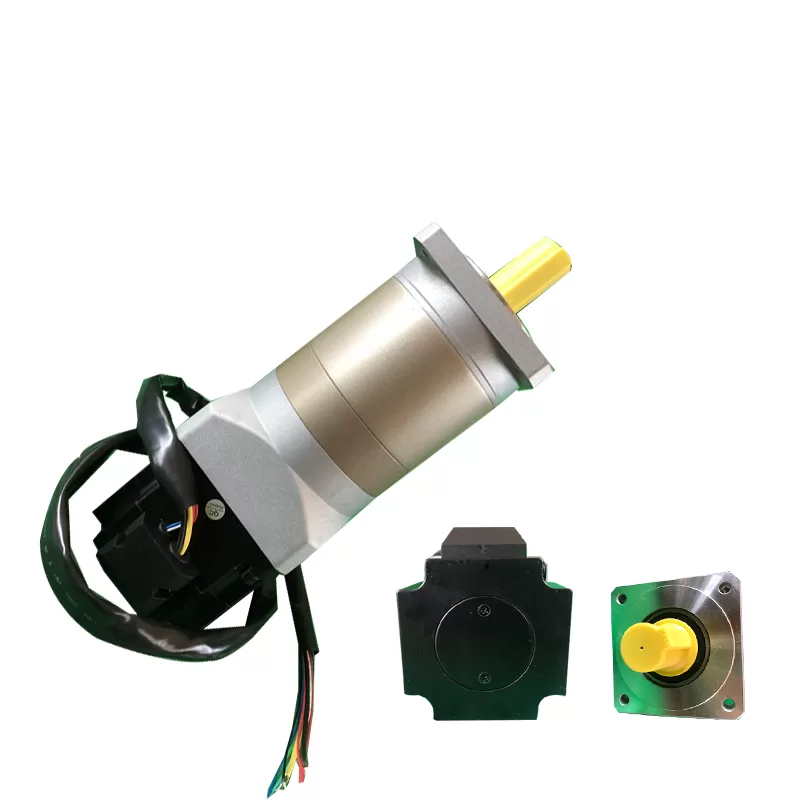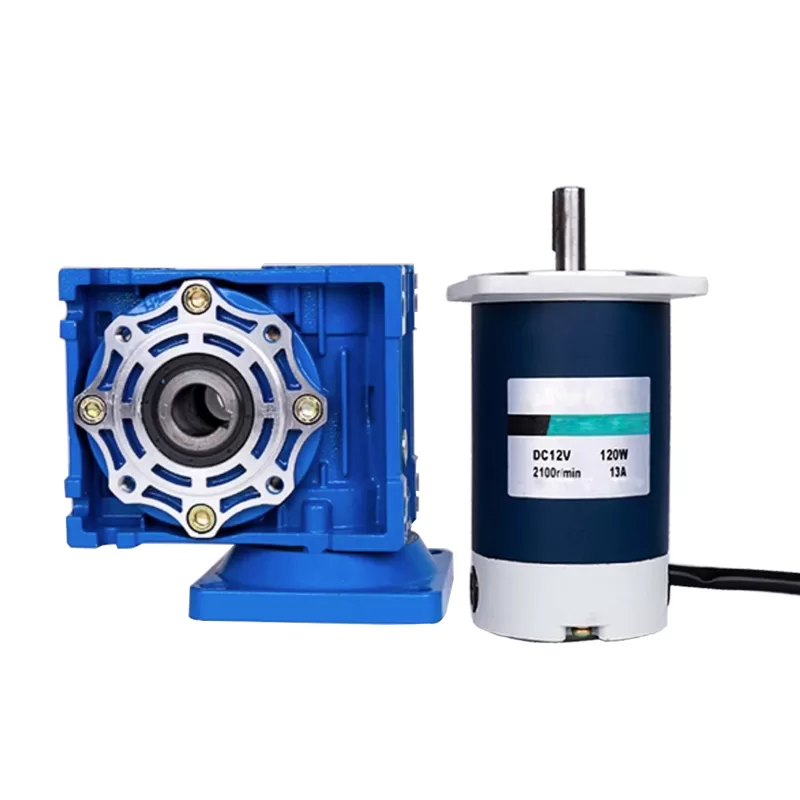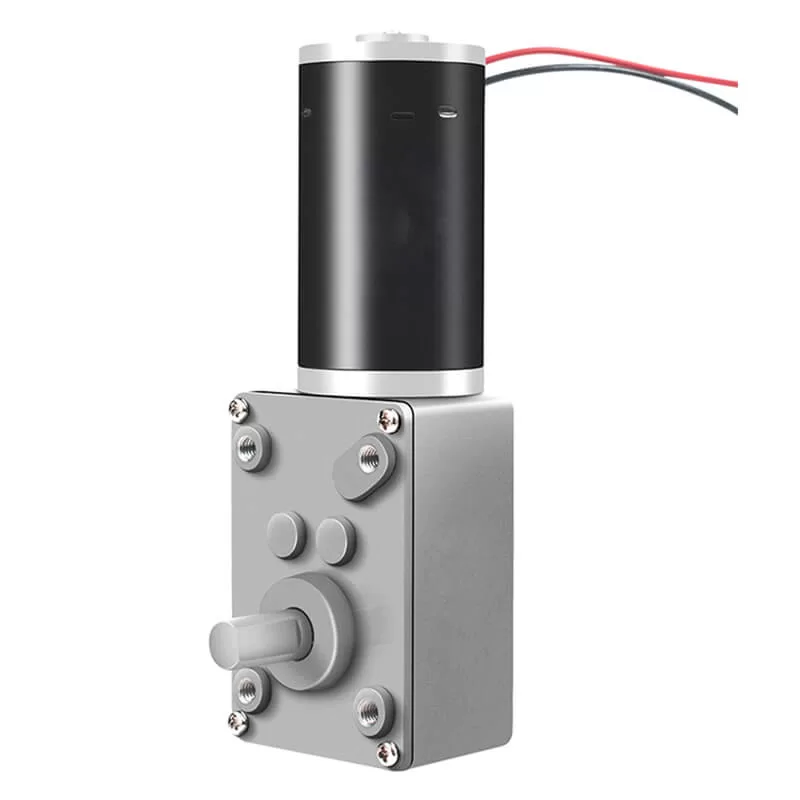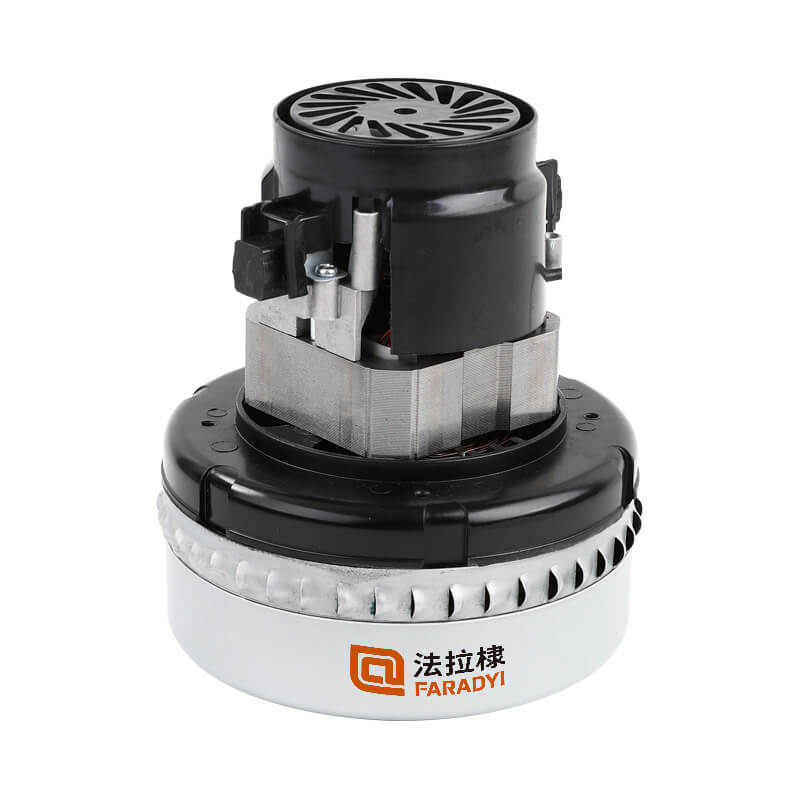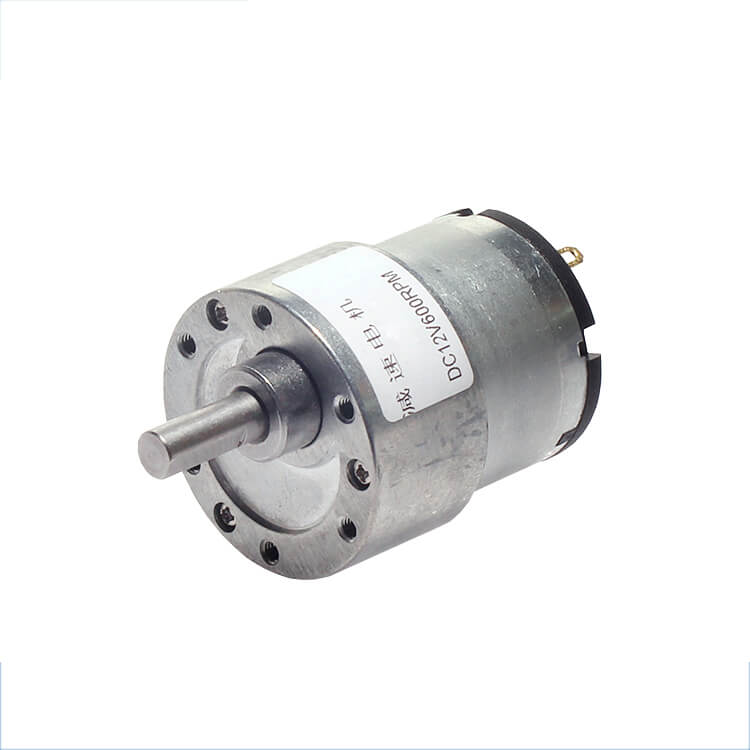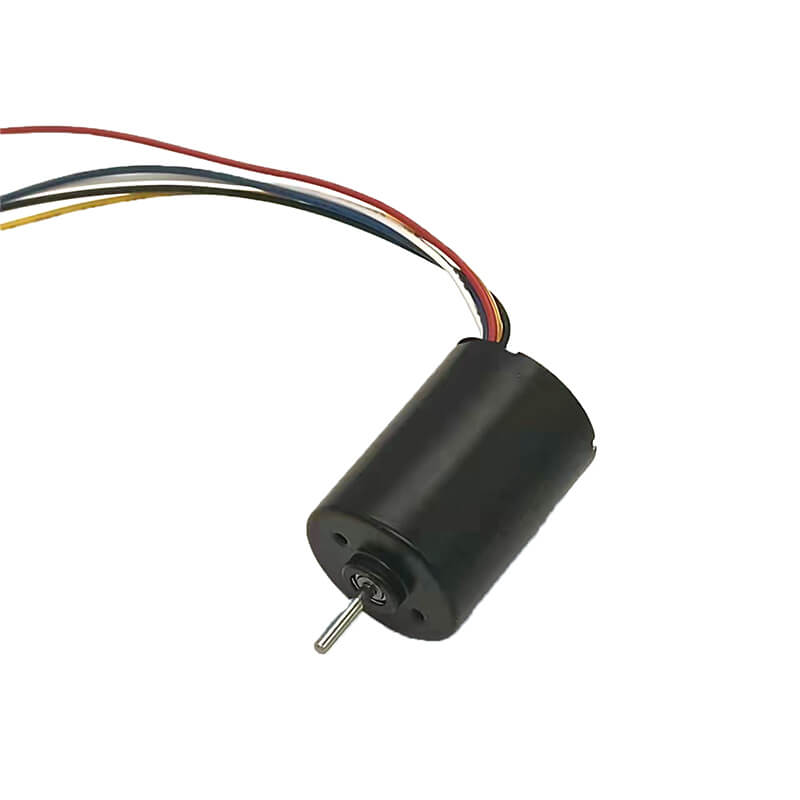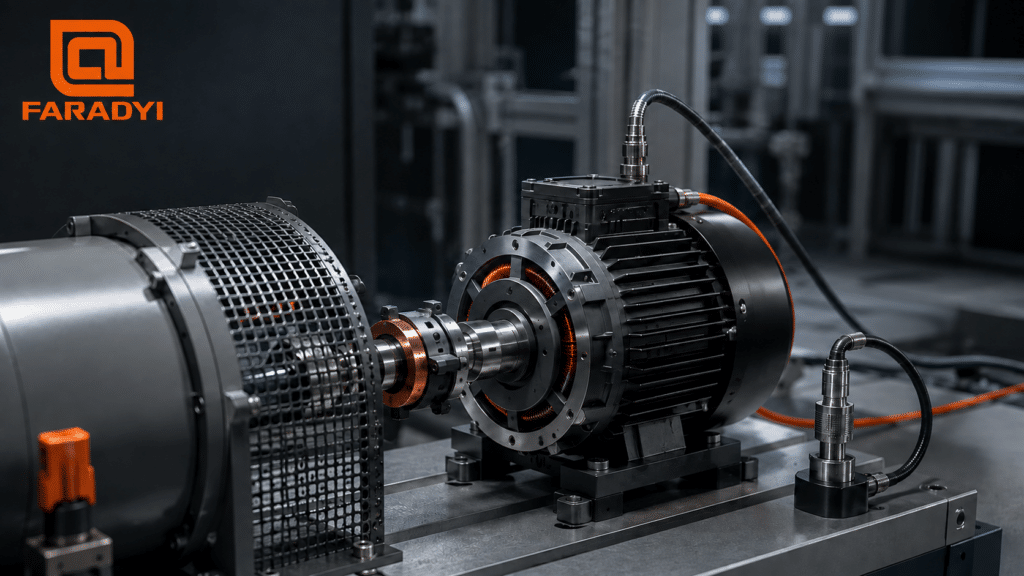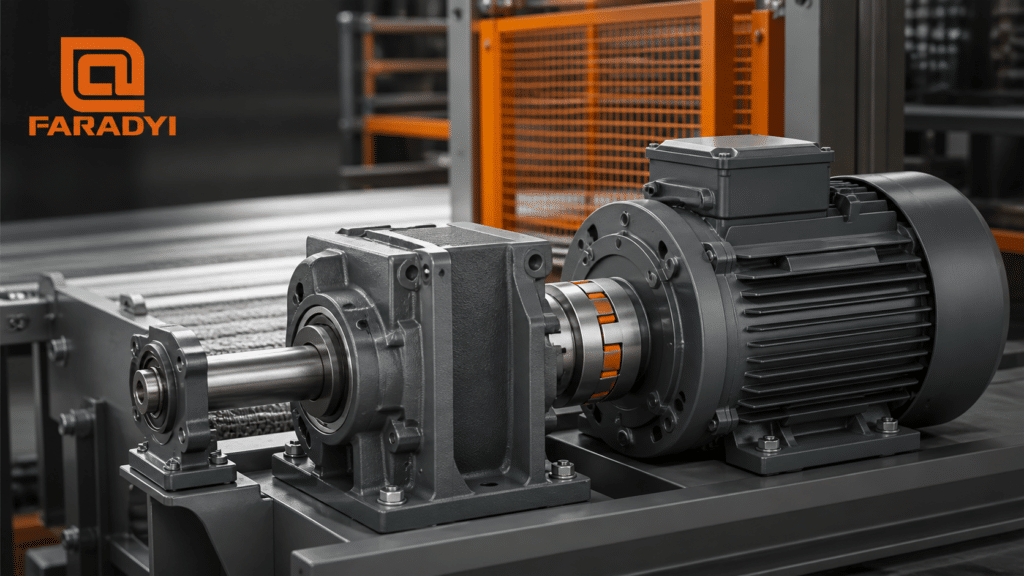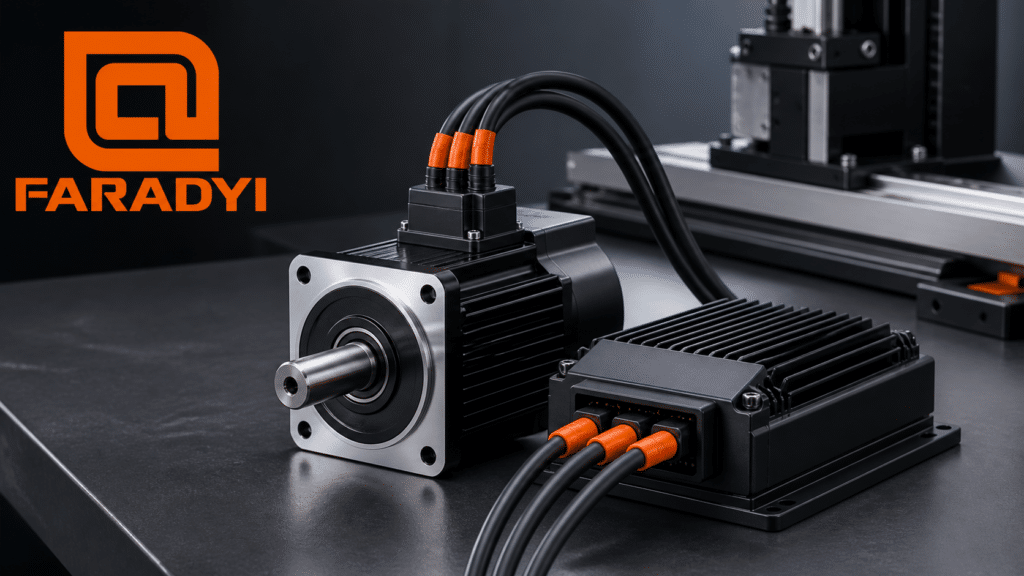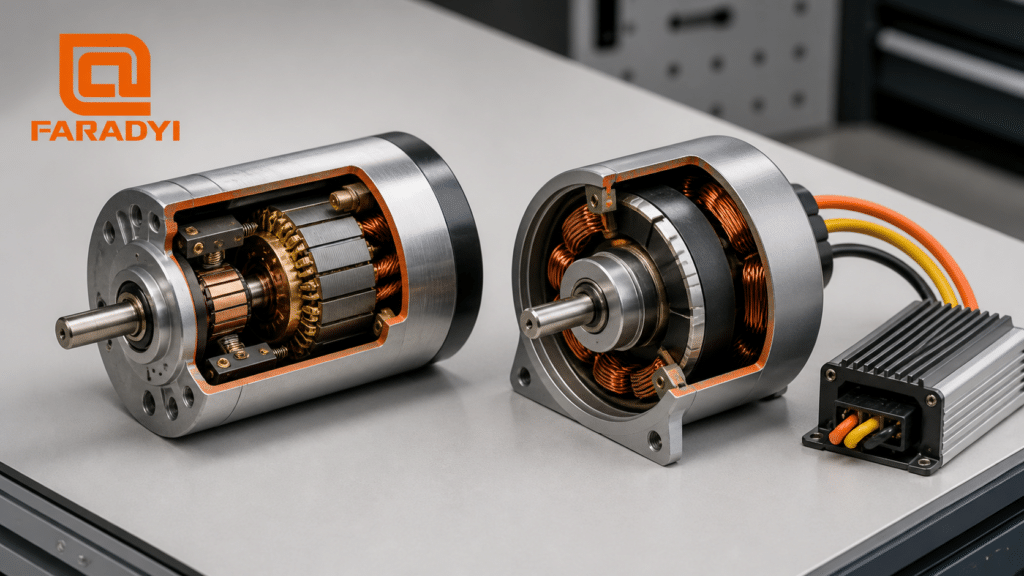
In a DC motor brushed vs brushless comparison, the main difference is how current is switched through the windings. A brushed DC motor uses carbon or metal brushes and a mechanical commutator. A brushless DC motor uses electronic switching—typically through an inverter or motor driver—based on rotor-position information or a sensorless control method.
DC Motor Brushed vs Brushless: Comparison at a Glance
| Factor | Brushed DC motor | Motor CC sin escobillas |
|---|---|---|
| Conmutación | Mechanical brushes and commutator | Electronic controller or inverter |
| Typical external connection | Often two power leads | Often three phase leads plus optional sensor wiring; integrated-drive versions vary |
| Basic control | Simple voltage/PWM control; reverse polarity or use an H-bridge | Requires compatible commutation electronics |
| Wear component | Brushes and commutator wear | No brushes; bearings and other components still age |
| Maintenance | Brush inspection or replacement may be required | Usually less routine motor maintenance |
| Commutation sparks and dust | Possible at brush contact | No brush-contact sparking or brush dust |
| System complexity | Lower for basic one-direction operation | Higher because commutation is electronic |
| Initial system cost | Often lower for simple applications | Often higher after including controller and feedback needs |
| Best fit | Cost-sensitive, simple, or intermittent-duty mechanisms | Long-life, high-duty, compact, or advanced-control systems |
On a phone, swipe the table horizontally to view every column.
This table describes common tendencies, not guaranteed specifications. A well-designed brushed motor can outperform a poorly matched brushless system in a particular duty point. Compare model-specific torque-speed curves, efficiency maps, thermal limits, controller losses, and service-life data.
How a Brushed DC Motor Works
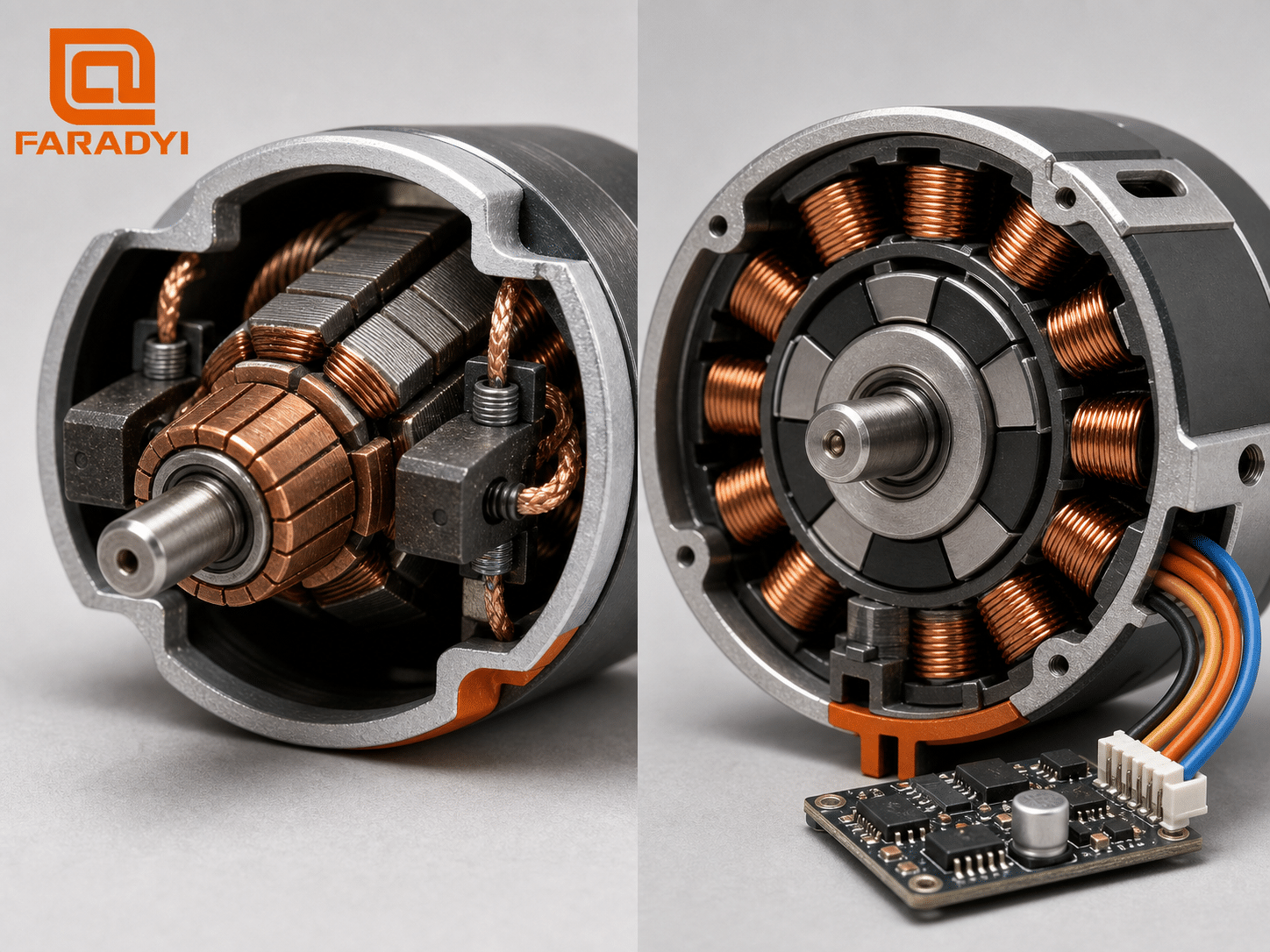
In a typical permanent-magnet brushed DC motor, stationary magnets create the field and windings are mounted on the rotor. Brushes press against segmented copper commutator bars. As the shaft rotates, the commutator mechanically changes which rotor windings carry current and reverses current at the correct angular position. The resulting magnetic interaction produces continuous torque.
This internal mechanical switching makes basic operation easy. Apply the rated DC voltage within the manufacturer’s limits and the motor turns; reverse polarity and the direction reverses. Pulse-width modulation (PWM) can regulate average voltage, while an H-bridge provides electronic reversing and braking functions.
Brushed motor advantages
- Simple drive electronics for basic operation
- Low initial cost in many small and cost-sensitive systems
- High starting torque is available in appropriately selected designs
- Straightforward speed control and direction reversal
- Useful for intermittent mechanisms where brush life exceeds the product-life target
Brushed motor limitations
- Brush and commutator wear limit service intervals or motor life
- Brush friction and electrical contact losses generate heat
- Mechanical commutation can create electrical noise, acoustic noise, brush dust, and sparking
- Very high speed and long continuous duty can accelerate brush wear
- Maintenance access may be difficult in sealed or remote equipment
How a Brushless DC Motor Works
In a common brushless DC motor, permanent magnets are on the rotor and multi-phase windings are fixed in the stator. A controller switches current through the stator phases in sequence, producing a rotating magnetic field that pulls the rotor around. Because commutation is electronic, there are no brushes touching a rotating commutator.
The controller must know or estimate rotor position. Some systems use Hall-effect sensors or an encoder. Others estimate position from back electromotive force or another sensorless method. Therefore, the claim that every brushless motor requires Hall sensors is incorrect.
Brushless motor advantages
- No brush or commutator wear
- Lower routine maintenance in many applications
- No brush-contact sparks or brush dust
- Stator windings can often transfer heat to the housing more effectively
- Electronic control can support wide speed ranges, controlled acceleration, diagnostics, and closed-loop regulation
- High power density and efficiency are possible in a well-designed motor-drive system
Brushless motor limitations
- A compatible electronic controller is mandatory
- Motor, controller, feedback, firmware, and wiring compatibility must be confirmed
- Initial system cost and development complexity may be higher
- Switching electronics can still generate electromagnetic interference
- Sensorless control may have limitations at startup or very low speed, depending on the algorithm and load
How to Tell if a DC Motor Is Brushed or Brushless
The safest identification method is the manufacturer’s part number, nameplate, wiring diagram, or datasheet. Physical clues can help, but none should override verified documentation.
Check the power leads
A basic permanent-magnet brushed motor often has two power terminals or two wires. A typical external-drive three-phase BLDC motor often has three heavier phase wires and may also have a smaller Hall-sensor or encoder connector.
However, wire count is not proof. A brushless motor with integrated electronics may accept two power wires, power plus a control input, or a digital communication connection. A brushed motor may also have extra wires for an encoder, thermal sensor, brake, or electromagnetic interference components.
Look for brushes or brush access
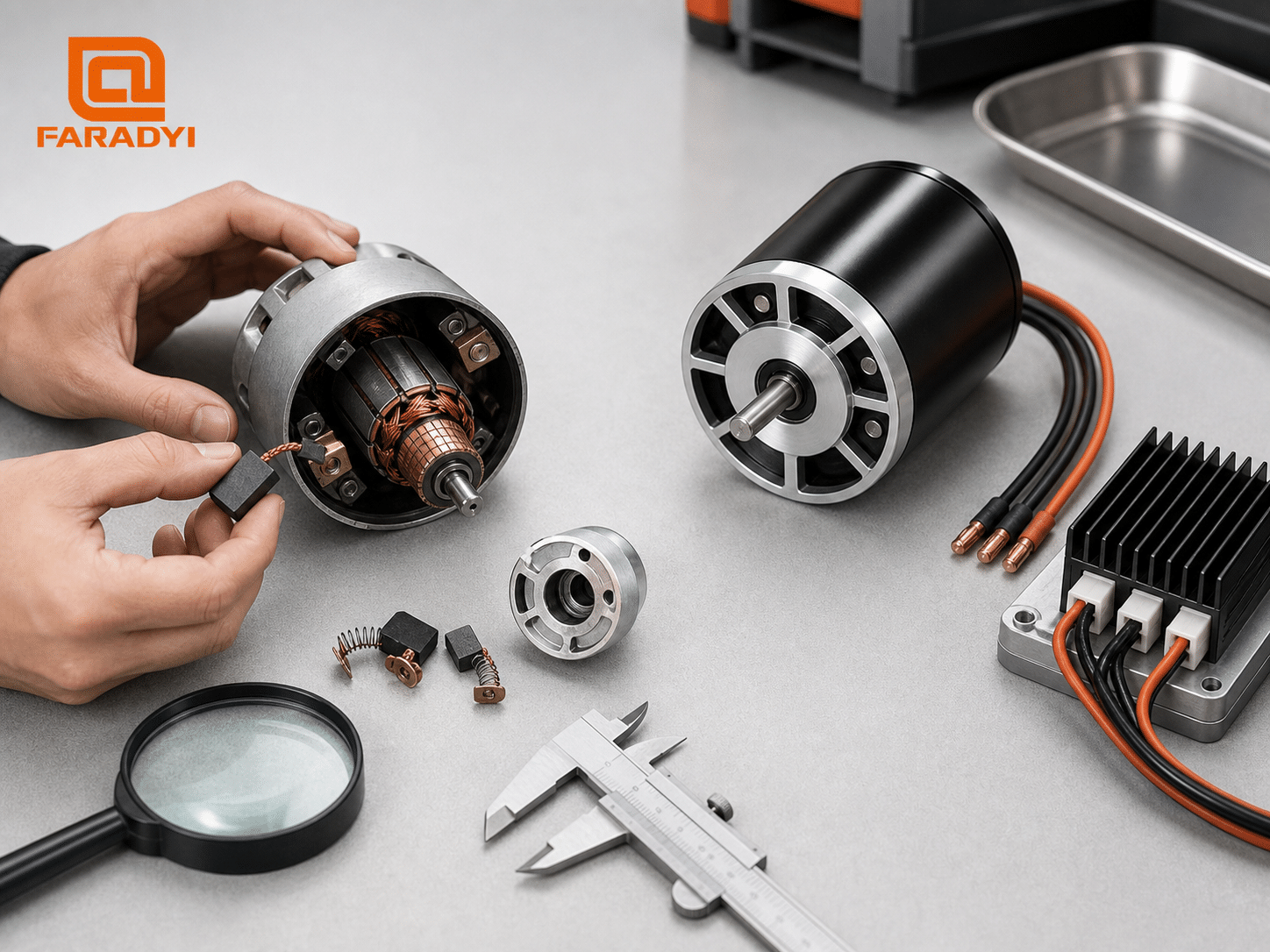
Some serviceable brushed motors have brush caps, holders, springs, or ventilation openings near the commutator end. Small sealed brushed motors may provide no external access, so absence of brush caps does not prove that a motor is brushless.
Inspect only when safe and permitted
If the motor is designed for disassembly and is fully disconnected, internal inspection can reveal the mechanism. A segmented copper commutator with spring-loaded brushes identifies a mechanically commutated motor. Fixed stator windings around a permanent-magnet rotor and electronic phase wiring indicate a brushless design.
Efficiency and Heat: Brushless Is Often—but Not Always—Higher
Brushless systems commonly eliminate brush voltage drop and friction and place heat-producing windings on the stator, where heat can often reach the housing more directly. These characteristics can improve efficiency and continuous power density.
But efficiency is a measured operating-point result, not a rule derived only from commutation type. Motor size, winding, magnetic design, bearings, controller switching losses, speed, torque, cooling, and duty cycle all matter. Some specialized brushed motors can be highly efficient at their intended operating point. Compare the complete motor-drive efficiency map or measured data for the actual load.
Torque, Speed, and Control
Both brushed and brushless motors can deliver high torque, run at high speed, use gearboxes, and support feedback control when designed for those tasks. It is inaccurate to say that brushed motors are inherently low-speed or low-power.
Brushed DC control
For a simple load, motor speed broadly follows applied voltage and torque broadly follows current within the operating region. PWM and an H-bridge can provide efficient speed regulation and reversing. Add an encoder and controller when precise speed or position control is required.
Brushless DC control
A BLDC controller electronically commutates the phases. Six-step, sinusoidal, and field-oriented control are examples of drive strategies with different cost, noise, smoothness, and performance tradeoffs. Confirm the motor’s phase current, voltage, sensor arrangement, pole count, and commutation requirements before selecting a controller.
Service Life and Maintenance
Brush wear makes operating life a central question for brushed motors. Actual brush life varies widely with current density, speed, duty cycle, brush material, commutator condition, temperature, humidity, vibration, contamination, direction reversals, and electrical arcing. A generic life-hour claim should not be used for procurement.
Brushless motors remove that wear mechanism, but they are not maintenance-free forever. Bearings, seals, insulation, magnets, connectors, cables, sensors, and controller components remain subject to temperature, vibration, contamination, and electrical stress. Request service-life assumptions and validation data for the actual model and operating profile.
Noise, EMI, and Sensitive Environments
Brushed motors can generate broadband electrical noise as the brushes make and break contact with commutator segments. They may also produce mechanical brush noise and visible sparking. Filters, shielding, grounding, cable routing, and suitable drive electronics can reduce system-level electromagnetic interference, but they do not remove brush wear.
Brushless motors avoid brush-contact noise and sparks, yet their inverter switches current rapidly and can generate conducted and radiated EMI. Motor cables, controller layout, switching frequency, grounding, and filters still matter.
A brushless motor is not automatically approved for a hazardous location, cleanroom, medical device, or aerospace system. Those uses require model-specific materials, validation, risk analysis, and certifications appropriate to the final equipment.
Total Cost: Compare the Whole System
For a simple low-duty mechanism, a brushed motor can minimize motor, controller, software, and commissioning cost. For high annual operating hours or difficult service access, a brushless system’s higher initial cost may be offset by fewer brush replacements, less downtime, improved energy use, or longer service intervals.
Include these costs in the comparison:
- motor and gearbox;
- driver or controller;
- feedback sensors and cables;
- software development and tuning;
- cooling and electromagnetic-compatibility measures;
- scheduled maintenance and replacement labor;
- downtime and access cost;
- energy over the expected operating profile.
Typical Applications
Where brushed DC motors often fit
- Intermittent automotive comfort mechanisms
- Simple locks, latches, valves, and small actuators
- Cost-sensitive toys and consumer mechanisms
- Basic pumps or tools where service life and environment are acceptable
- Low-volume prototypes needing straightforward two-wire operation
Where brushless DC motors often fit
- Fans, blowers, pumps, and compressors with long operating hours
- Robotics, automated equipment, and controlled motion
- Drones and other weight-sensitive propulsion systems
- Battery-powered products where motor-drive efficiency matters
- High-speed spindles and compact, high-duty equipment
These are common patterns, not automatic selections. An application can use either technology when the motor and system meet the required torque, speed, life, environment, noise, safety, and cost targets.
How to Choose Between Brushed and Brushless Motors
- Define the motion. Record loaded speed, continuous torque, peak torque, start/stop frequency, reversals, and duty cycle.
- Estimate expected life. Include daily operating hours, total product life, and acceptable maintenance intervals.
- Review the environment. Consider temperature, moisture, dust, vibration, acoustic limits, EMI sensitivity, and any concern about brush dust or sparking.
- Define control needs. Decide whether simple on/off operation, variable speed, reversing, torque control, position control, or network communication is required.
- Evaluate power and thermal limits. Use model-specific torque-speed curves and thermal data at the intended voltage and cooling condition.
- Check mechanical integration. Compare envelope, flange, shaft, bearings, gearbox, connectors, mass, and cable direction.
- Compare total system cost. Include electronics, engineering, maintenance, downtime, and energy—not only motor price.
- Validate under real conditions. Test temperature, noise, efficiency, control response, service life, and failure behavior with a representative load.
Selection Decision Table
| Application priority | Technology to evaluate first | Why | Verify before choosing |
|---|---|---|---|
| Lowest cost for simple intermittent motion | Brushed | Simple motor and drive architecture | Brush life still exceeds product target |
| Long continuous duty with limited service access | Sin escobillas | No brush replacement interval | Bearing, controller, and thermal life |
| Basic two-wire operation | Brushed | Mechanical commutation is internal | Current, reversing, braking, and protection needs |
| Advanced electronic speed or torque control | Sin escobillas | Commutation and regulation are already electronic | Feedback, firmware, drive, and motor compatibility |
| No brush dust or brush-contact sparks | Sin escobillas | No mechanical brush contact | Final-system environmental certification and electronic EMI |
On a phone, swipe the table horizontally to view every column.
What to Provide for a Motor Recommendation or Quote
Useful application data allows a supplier to compare both technologies objectively. Provide:
- supply voltage and available current;
- loaded speed range;
- continuous and peak torque;
- complete duty cycle, starts, stops, and reversals;
- desired service life and maintenance interval;
- motor diameter, length, flange, shaft, and gearbox limits;
- ambient temperature, cooling, altitude, moisture, dust, and vibration;
- noise and EMI requirements;
- feedback, brake, controller, and communication needs;
- prototype quantity and expected annual volume.
Faradyi Motor offers both motores de corriente continua con escobillas y motores de corriente continua sin escobillas. Use the category pages to explore available motor types, then request model-specific curves, dimensions, controller requirements, and environmental limits before final selection.
Not Sure Which DC Motor Technology Fits?
Send Faradyi Motor your voltage, torque-speed requirement, duty cycle, installation space, environment, control needs, and quantity.
Preguntas frecuentes
Which is better: a brushed or brushless DC motor?
Neither is universally better. Brushed motors often win on simplicity and initial cost. Brushless motors often win on maintenance, long duty, and electronic-control capability. Select from the application’s verified requirements.
Can a brushless motor have only two wires?
Yes. A brushless motor with integrated commutation electronics may expose only power leads or a simplified power-and-control interface. Wire count is only a clue; check the datasheet.
Do all brushless motors use Hall sensors?
No. Some use Hall sensors or encoders, while sensorless controllers estimate rotor position from electrical behavior such as back EMF. The appropriate method depends on startup, low-speed, load, and control requirements.
Are brushless motors always more efficient?
No. Brushless systems often have efficiency advantages, but actual efficiency depends on the specific motor, controller, speed, torque, winding, cooling, and operating point. Compare measured model-specific data.
Can a brushed motor provide precise speed or position control?
Yes. A brushed motor can use an encoder and closed-loop controller. Brushless commutation and servo control are different concepts; either motor technology can be part of a feedback-controlled system.
Why do brushed motors create sparks?
As brushes transition between commutator segments, current is switched in inductive windings. The changing contact and stored magnetic energy can produce small arcs, especially under unfavorable current, speed, wear, or contamination conditions.
Does brushless mean maintenance-free?
No. Brushless motors eliminate brush maintenance, but bearings, seals, cables, connectors, cooling, sensors, and electronics still require appropriate design and inspection.
Can I replace a brushed motor with a brushless motor directly?
Usually not as a drop-in electrical replacement. The brushless motor needs a compatible controller, and its voltage, speed, torque, feedback, mounting, shaft, wiring, cooling, and control interface must match the machine.
Conclusión
The practical answer to DC motor brushed vs brushless is a tradeoff between mechanical simplicity and electronic commutation. Brushed motors remain strong choices for simple, cost-sensitive, intermittent applications. Brushless motors are often preferred for long duty, low routine maintenance, compact thermal design, and advanced control. Compare the complete motor-drive system at the actual load, then explore Faradyi’s brushed motor range y brushless motor range for an application-specific discussion.
Technical References