Stepper motor stalling happens when the rotor cannot keep up with the commanded motion. The motor may buzz, stop, or finish a move at the wrong position. Too much load is one possible cause, but wiring errors, driver faults, an unsuitable acceleration profile, and mechanical binding can produce similar symptoms.
Start by recording when the failure happens. A motor that stalls immediately needs a different investigation from one that runs correctly for twenty minutes and then stops.
Quick answer: Check the mechanism and winding connections first. Then verify driver status, current settings, supply voltage, speed, and acceleration. Change one setting at a time and repeat the same move. Do not increase current beyond the motor or driver’s documented limits.
Stepper motor stalling: match the symptom to the check
On a phone, swipe horizontally to read the table.
| Symptom | Possible causes | First checks |
|---|---|---|
| Buzzes without rotating | Incorrect phase pairing, binding, excessive starting demand | Winding diagram, free travel, low-speed test |
| Fails during acceleration | Insufficient accelerating torque or abrupt command | Ramp, inertia, running torque data |
| Stops at higher speed | Insufficient available torque, supply limitations | Matched motor-driver curve and supply at the drive |
| Fails in a narrow speed band | Resonance or mechanical excitation | Speed sweep, couplings, mounting, driver settings |
| Stops after warming up | Thermal protection or temperature-related changes | Fault log, current, cooling, duty cycle |
Separate a mechanical problem from an electrical one
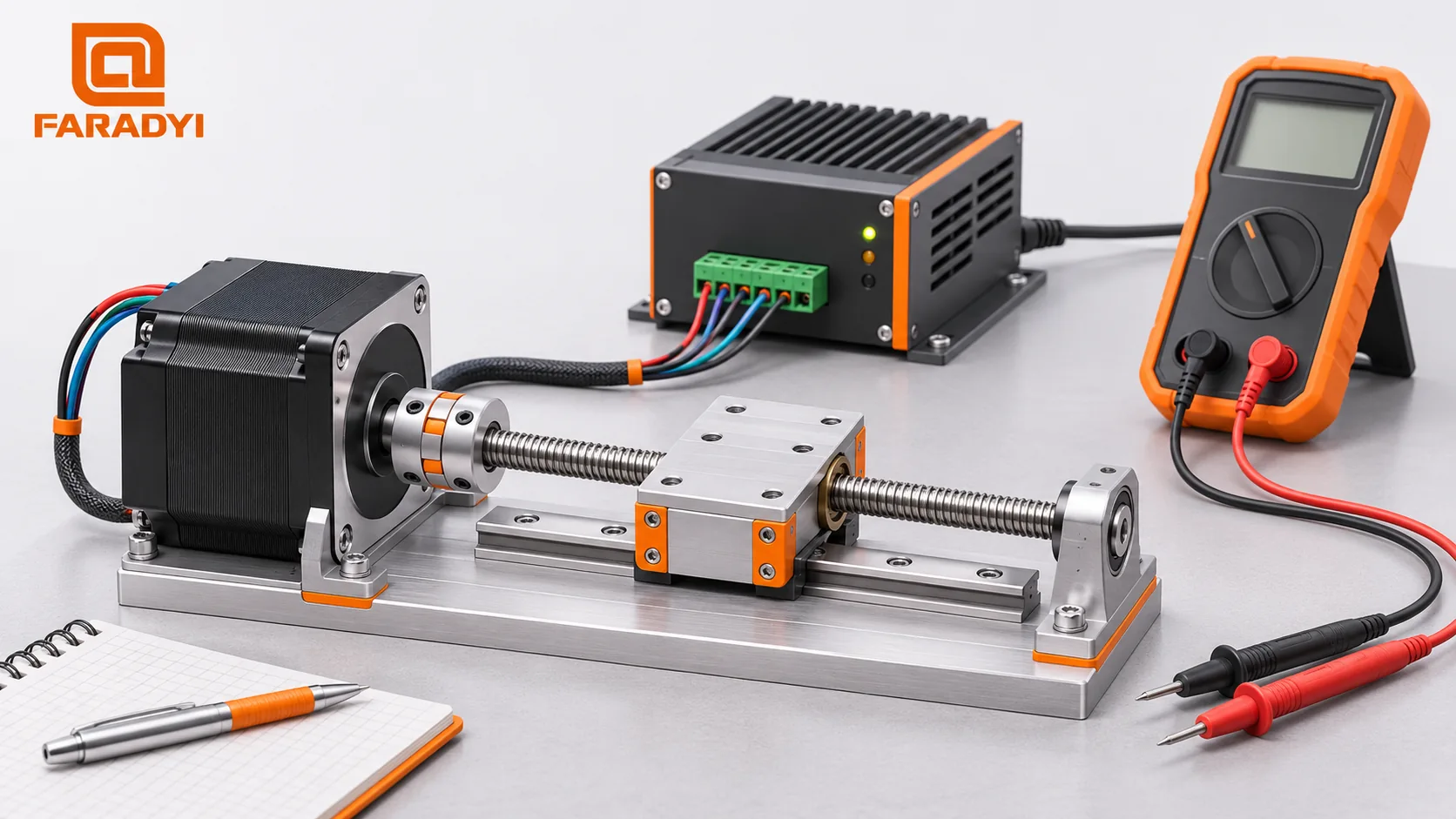
Inspect the full travel for obstructions, damaged bearings, screw misalignment, loose couplings, and changing friction. A carriage may move freely in one area and bind in another. Record whether the failure follows position, direction, speed, or time.
Before inspecting wiring or uncoupling a load, isolate power and secure any mechanism that could move unexpectedly. Follow the equipment’s service instructions. Never unplug a motor from an energized driver.
A carefully controlled unloaded test can help locate the problem, where the machine permits one. Passing that test does not prove that the motor is correctly sized for the real load.
Verify the motor-driver connection
Use the manufacturer’s winding diagram to identify phase pairs and the intended connection. Wire colors and connector shapes are not reliable substitutes for documentation. Check loose terminals, broken conductors, driver enable signals, and fault indications.
Confirm whether the configured current is RMS, peak, or another manufacturer-defined value. Also review idle-current reduction and what happens when motion resumes. A supply-current reading is not automatically the motor’s phase current.
Use running torque, not holding torque, to assess a move
Holding torque describes energized standstill behavior. For motion, use the torque-speed curve for the actual motor, driver, supply, and winding connection. Required torque includes the load and the additional demand during acceleration.
The start/stop region is different from the region the motor can reach using a ramp. A speed that is sustainable after acceleration may still be too high for a direct start. See Oriental Motor’s explanation of speed-torque curves.
There is no universal 300 ms ramp suitable for every machine. Choose acceleration and deceleration from the load, inertia, available torque, and required cycle time, then test the result with margin.
Check pulse rate, microstepping, and resonance
Increasing microstep resolution increases the number of input pulses needed for a given speed, unless the drive uses a different command arrangement. Verify the controller’s output rate, pulse width, direction timing, and driver input requirements.
For a calculation example, a 200-full-step motor at 16 microsteps per step needs 3,200 command pulses per revolution. At 300 rpm, that is 16,000 pulses per second. These are example settings, not a Faradyi product specification.
Microstepping can smooth motion, but it does not guarantee sufficient torque or eliminate missed moves. Mechanical resonance also depends on the complete assembly; it does not always occur at one fixed rpm. Read our stepper motor types guide for the distinction between resolution and accuracy.
A repeatable troubleshooting sequence
- Record a baseline. Save the motor model, driver settings, load, command profile, fault status, and failure point.
- Inspect mechanics and connections. Resolve binding and wiring problems before tuning.
- Reduce motion demand. Test a lower speed and gentler ramp while holding other variables constant.
- Check electrical limits. Confirm the supply and current settings against the selected products’ documentation.
- Repeat the complete cycle. Include reversals, the heaviest expected load, warm operation, and the full travel.
- Verify final position. A quiet move is not proof that it completed correctly. Use an appropriate position check and reference procedure.
When feedback or a different motor may help
Closed-loop feedback can help detect and respond to position error, but the drive’s response must be understood. Feedback does not create unlimited torque, and a motor-mounted encoder may not detect backlash farther down the transmission.
If the required operating point cannot be achieved with suitable margin, reassess motor size, gearing, drive capability, or the motion profile. Our servo versus stepper guide discusses another possible system choice.
Frequently asked questions
Does stalling mean the motor is damaged?
No. An intact motor can lose synchronism when demand exceeds available torque. Electrical faults or mechanical damage are also possible, so symptoms alone are not a diagnosis.
Should I raise the driver current?
Only after checking the specified limits and identifying the cause. Excess current can increase heating without correcting binding, poor wiring, or an unsuitable speed profile.
Can a stalled motor still draw current?
Yes. Energized windings can continue producing heat even when the shaft stops. Check the drive’s protection behavior and stop an unsuccessful test rather than leaving it stalled.
Resolve the cause before changing the hardware
Reliable diagnosis of stepper motor stalling comes from linking the symptom to a repeatable test. Browse Faradyi stepper motors and drivers ou send an application inquiry with the motor and driver models, supply, current settings, load, speed, acceleration, duty cycle, and failure details.