How to Fix Overheating and Smoke in BLDC Motors
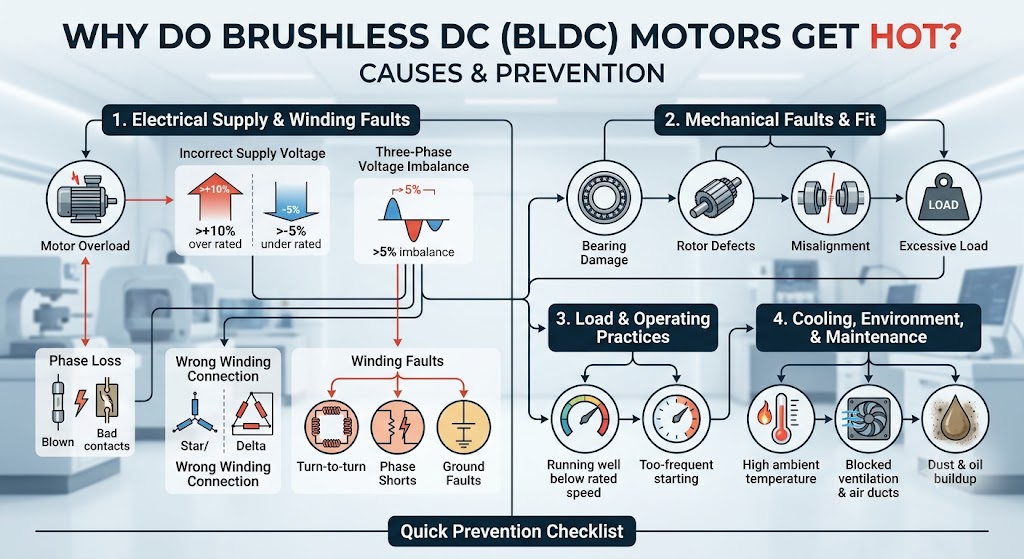
The Bottom Line (Key Takeaway): Finding the right Brushless motor temperature problem solution is critical to preventing permanent equipment failure when your motor starts smoking or overheating. Most high-temperature abnormalities stem from four core areas: improper power supply voltage, excessive mechanical load, blocked environmental ventilation, or internal winding faults.
Below is a structured, quick-reference diagnostic guide to help you troubleshoot and solve these issues efficiently.
1. Power Supply & Electrical Wiring Issues
Incorrect power delivery is the most common cause of overheating.
-
Voltage Too High: This causes the core magnetic flux density to oversaturate, driving the temperature up rapidly. 解決: Contact your power supply department to regulate and lower the voltage.
-
Voltage Too Low (Under Rated Load): If the voltage drop is caused by a thin power line, replace it with a thicker wire. If the source itself is too low, request a voltage increase.
-
Running in Two Phases: Missing a phase will cause immediate heating. 解決: Check melting wires and switch contact points immediately.
-
Wiring Errors: Connecting a Y-connected motor in a Δ (Delta) configuration (or vice versa) will cause severe electrical stress. 解決: Correct the wiring strictly according to the manual.
2. Mechanical & Load Issues
Physical resistance forces the motor to draw more current, converting excess energy into heat.
-
Stator-Rotor Rubbing: Physical friction generates immense heat. 解決: Check for excessive bearing clearance (replace bearings if needed), investigate bent rotating shafts, and repair any loose or deformed cores.
-
Severe Overloading: If the mechanical drag is too high, the motor works beyond its capacity. 解決: Reduce the mechanical resistance. If the load cannot be reduced, you must upgrade to a larger-capacity brushless motor.
-
Frequent Starts & Reversals: Constant starting and reversing generate heat surges. 解決: Optimize your duty cycle to reduce frequent stops/starts, or select a motor designed for high-frequency cycling.
3. Environmental & Cooling System Failures
Even a perfectly healthy motor will overheat if it cannot dissipate heat.
-
Blocked Ventilation & Dirt: Dirt on the winding surface acts as insulation. 解決: Inspect and thoroughly clean the motor, ensuring all ventilation ducts are unobstructed.
-
High Ambient/Inlet Air Temperature: 解決: Improve ambient conditions by taking active cooling measures, isolating nearby high-temperature heat sources, and shielding the motor from direct sunlight.
4. Internal Motor & Winding Faults
If the exterior and power supply are fine, the issue is likely internal.
-
Short Circuits: Shorts between winding turns, phase-to-phase, or grounding will cause smoke. 解決: Troubleshoot with a multimeter; the motor may require replacement.
-
Rotor Issues (Broken Bars/Loose Connections): 解決: Identify broken bars or loose spots on the rotor and re-weld or tighten fixing screws.
-
Poor Impregnation: If rewound poorly, the winding won’t dissipate heat well. 解決: A secondary vacuum impregnation process is required.
-
Burned Iron Core: If wire burning has damaged the iron core, iron loss increases significantly. 解決: Perform core testing and repair the iron core.
Q&A: Quick Diagnostic Scenarios
Q: My brushless motor is overheating or smoking—what should I check about the power supply first?
A: Verify that the supply voltage is within the specified range. If it is too high, the core’s magnetic flux density oversaturates. If it is too low, use a thicker power line to reduce voltage drop.
Q: Can mechanical issues cause high temperatures?
A: Yes. Stator-rotor rubbing generates excess heat. Check for worn bearings, a bent shaft, or a loose core. Also, confirm the motor isn’t overloaded by the driven mechanism.
Q: How do dirt and ventilation problems lead to overheating?
A: Dirt on windings blocks heat dissipation. If the inlet air or ambient temperature is high, or ducts are blocked, the motor runs hot. Clean the motor and isolate it from external heat sources.
Q: What internal electrical faults cause smoke?
A: Shorts between turns, phase-to-phase faults, or ground faults will rapidly overheat the windings. Running in two phases or having broken rotor bars will also trigger severe heating and smoke.