A permanent magnet is a material that produces and retains its own magnetic field without needing a continuous electrical power supply. It has two magnetic poles—north and south—and continues to attract or repel other magnetic materials after the external magnetizing force has been removed.
Permanent magnets are found in electric motors, generators, speakers, sensors, tools, medical equipment, consumer electronics, and many other products. Their performance depends on the magnetic material, temperature, shape, operating environment, and resistance to demagnetization.
This guide explains what a permanent magnet is, how it works, the main material types, how it differs from an electromagnet, and what engineers should consider when selecting permanent magnets for motors and other applications.
What Is a Permanent Magnet?
A permanent magnet is an object made from a magnetically hard material that remains magnetized after the field used to magnetize it is removed. Unlike an electromagnet, it does not require current flowing through a coil to maintain its magnetic field.
The word “permanent” does not mean that the magnet can never weaken. It means the material is designed to retain a useful level of magnetization for a long time under its specified operating conditions. Excessive temperature, a strong opposing magnetic field, corrosion, mechanical damage, or an unsuitable magnetic circuit can reduce its performance.
Every permanent magnet has a north pole and a south pole. Opposite poles attract, while like poles repel. If a magnet is divided into smaller pieces, each piece forms its own north and south poles rather than producing an isolated magnetic pole.
How Does a Permanent Magnet Work?
Magnetism originates from the magnetic moments associated with electrons. Inside a ferromagnetic or ferrimagnetic material, groups of atomic magnetic moments can align in regions known as magnetic domains.
In an unmagnetized material, many domains point in different directions, so their magnetic effects largely cancel one another. During magnetization, a sufficiently strong external magnetic field encourages more domains to align in a preferred direction.
A permanent-magnet material has high resistance to having that alignment reversed. After the external magnetizing field is removed, much of the alignment remains, allowing the object to produce a persistent external magnetic field.
Three important properties help engineers compare permanent-magnet materials:
- Remanence: the magnetization or magnetic flux density that remains after the magnetizing field is removed.
- Coercivity: the material’s resistance to demagnetization by an opposing magnetic field.
- Maximum energy product: an indication of how much useful magnetic energy the material can provide per unit volume.
These properties are related, but they are not interchangeable. The strongest magnet at room temperature is not automatically the best choice for a high-temperature, corrosive, or cost-sensitive application.
What Are Permanent Magnets Made Of?
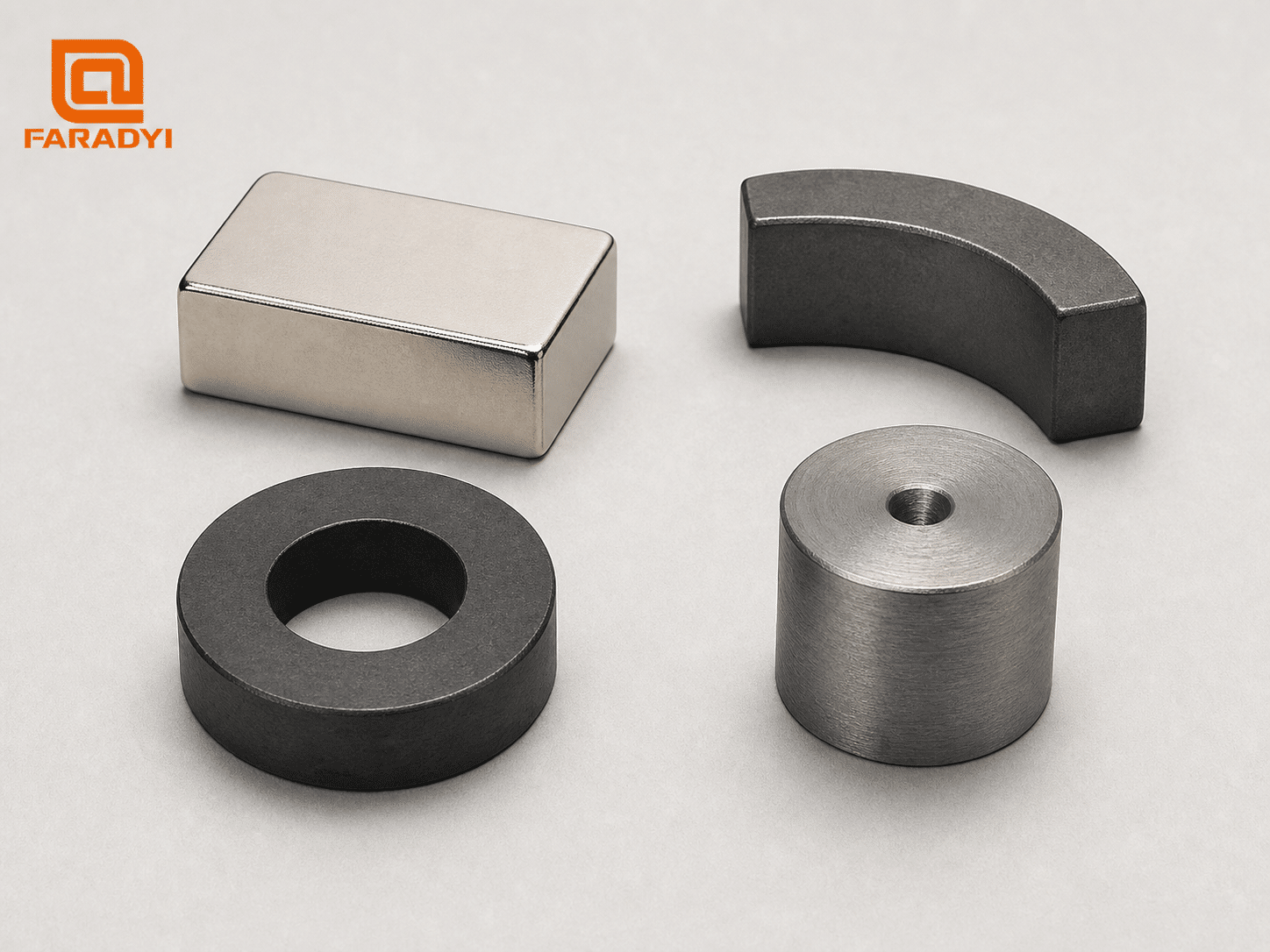
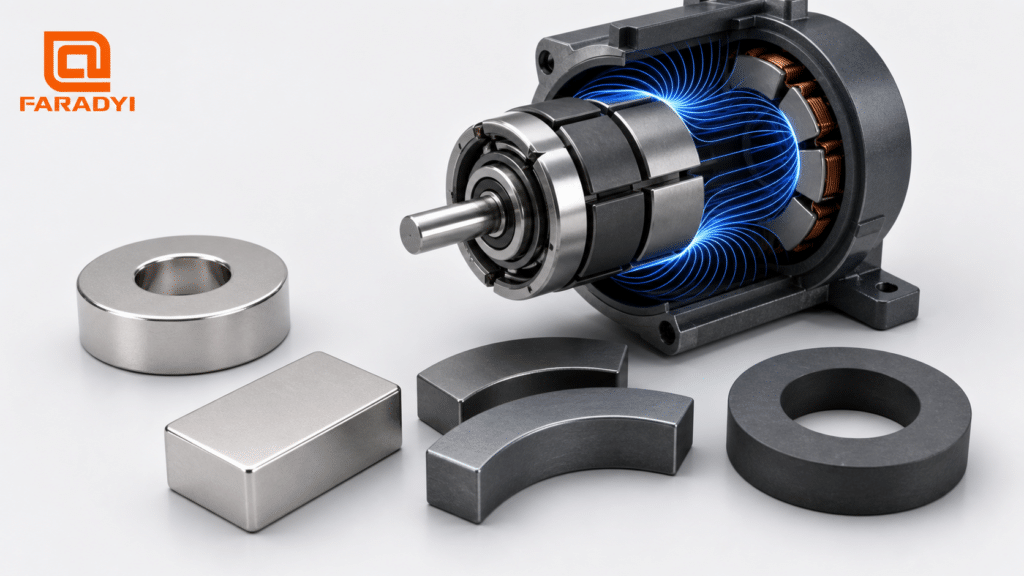
The four most common commercial permanent-magnet material families are neodymium-iron-boron, samarium-cobalt, ceramic ferrite, and Alnico. Each offers a different balance of magnetic strength, temperature capability, cost, corrosion behavior, and mechanical characteristics.
Neodymium-Iron-Boron Magnets
Neodymium-iron-boron, commonly abbreviated as NdFeB, is a rare-earth magnet material known for very high magnetic strength relative to its size. It enables compact magnetic circuits and high torque density in many modern products.
NdFeB magnets are widely used in permanent-magnet motors, robotics, electric vehicles, generators, sensors, speakers, and compact electronic devices. Because many grades are susceptible to corrosion, manufacturers often apply nickel, epoxy, or another protective coating.
Temperature capability varies substantially by grade. Engineers must evaluate the actual magnet grade and operating point instead of assuming that every neodymium magnet has the same thermal limit.
Samarium-Cobalt Magnets
Samarium-cobalt, or SmCo, is another rare-earth permanent-magnet material. It is valued for good magnetic stability and performance in elevated-temperature or demanding environments.
SmCo magnets can be appropriate for aerospace, precision instrumentation, high-temperature motors, and applications where magnetic stability is more important than achieving the lowest material cost. They are generally more brittle and expensive than common ferrite magnets.
Ceramic Ferrite Magnets
Ceramic ferrite magnets are commonly made using iron oxide combined with barium or strontium compounds. They provide moderate magnetic performance at relatively low cost and have good corrosion resistance.
Ferrite magnets are widely used in speakers, household appliances, magnetic separators, simple sensors, and cost-sensitive electric motors. They are usually larger than rare-earth magnets when an application requires a similar magnetic output.
Alnico Magnets
Alnico magnets are based primarily on aluminum, nickel, cobalt, and iron. They can offer good temperature stability and are used in instruments, sensors, holding devices, and specialized electrical equipment.
Alnico generally has lower resistance to demagnetization than modern rare-earth materials. The magnet’s shape and surrounding magnetic circuit therefore require careful engineering.
Permanent Magnet Material Comparison
| Material | Relative magnetic strength | Temperature behavior | Cost level | Common uses |
|---|---|---|---|---|
| NdFeB | Very high | Grade-dependent; requires careful thermal selection | Medium to high | Compact motors, robotics, EVs, electronics |
| SmCo | High | Strong choice for elevated temperatures and stability | High | Aerospace, precision and high-temperature systems |
| Ferrite | Moderate | Good for many general-purpose applications | Low | Appliances, speakers, separators, economical motors |
| Alnico | Moderate | Good temperature stability | Medium | Sensors, instruments and specialized equipment |
General comparison only. Performance varies by grade, geometry, coating, supplier, and operating point. On a phone, swipe horizontally to view the complete table.
Permanent Magnet vs. Electromagnet
The main difference is how the magnetic field is maintained. A permanent magnet produces a field without continuous electrical power. An electromagnet normally produces its field when current passes through a coil.
| Characteristic | Permanent magnet | Electromagnet |
|---|---|---|
| Power needed to maintain field | No continuous power | Usually requires current |
| Field control | Not easily changed during operation | Can be adjusted, reversed, or switched off |
| Heat generation | No coil loss required to create the field | Coil current produces resistive heat |
| Typical use | Motors, sensors, speakers and holding devices | Relays, solenoids, lifting magnets and actuators |
A permanent magnet is useful when a stable field, compact size, and no excitation power are priorities. An electromagnet is preferable when the field must be turned on and off or adjusted dynamically.
How Permanent Magnets Are Used in Electric Motors
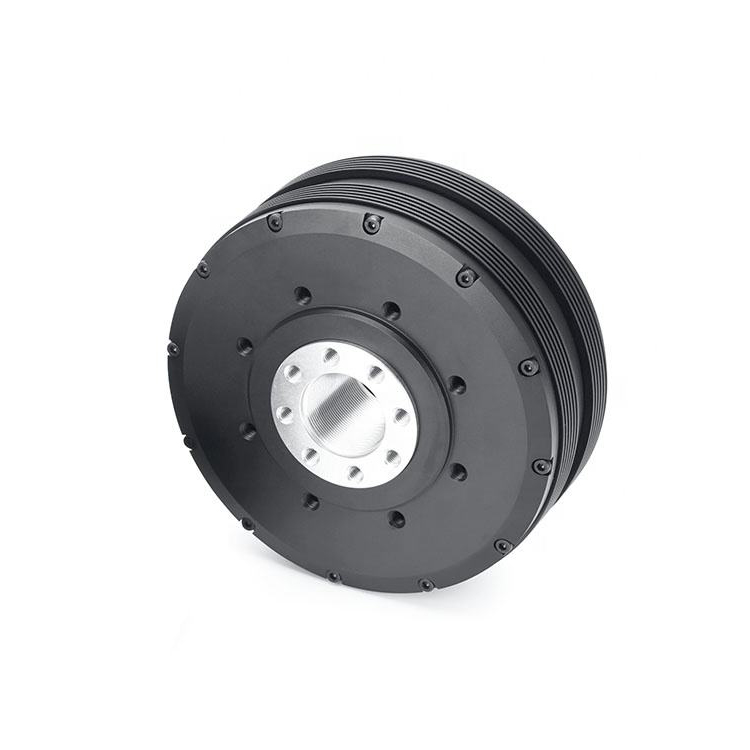
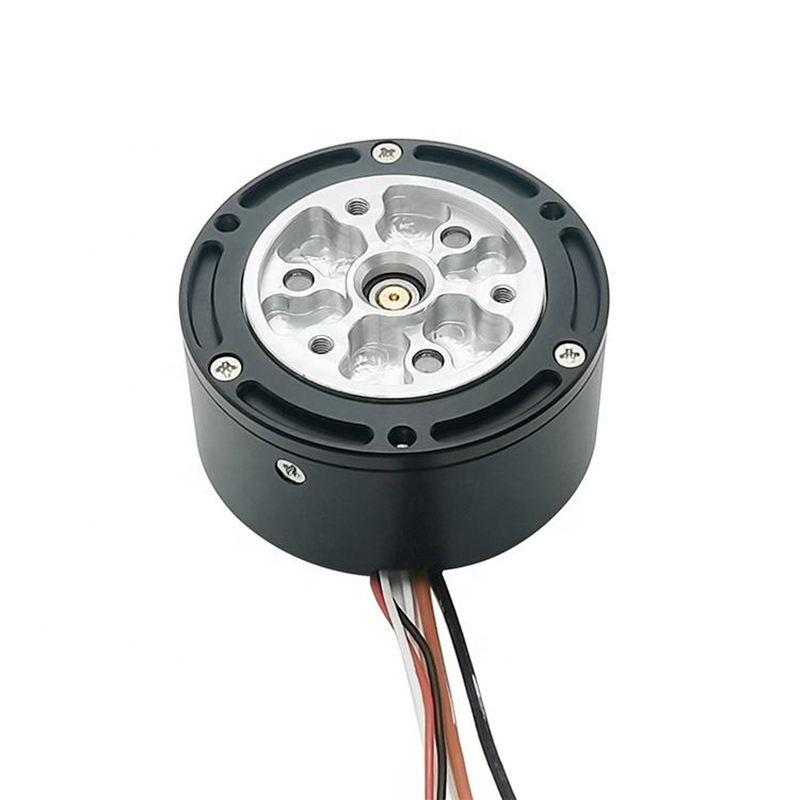
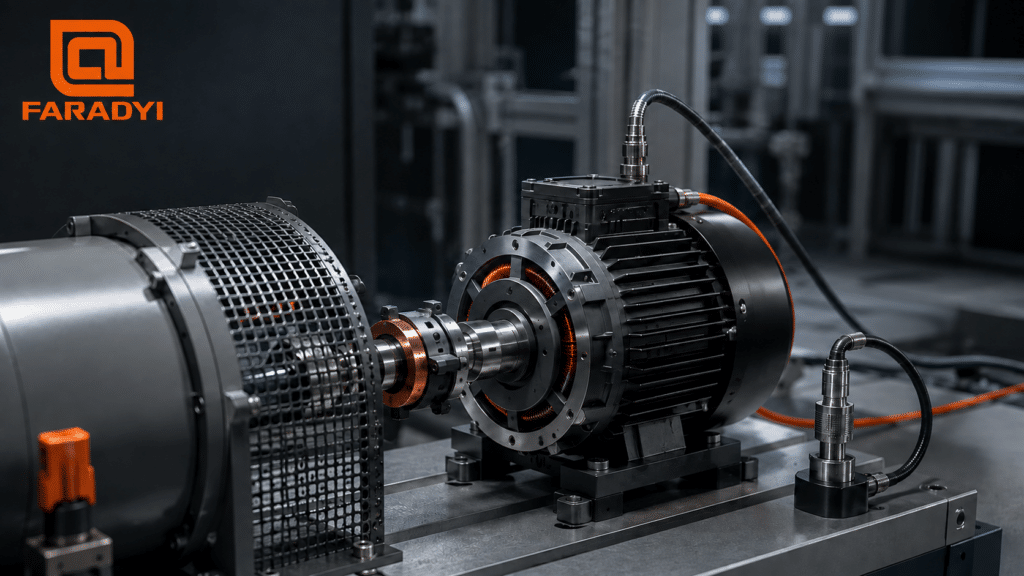
A permanent-magnet motor uses magnets to establish part or all of the magnetic field needed to produce torque. The permanent magnets interact with the magnetic field generated by current in the motor windings.
Using magnets for field excitation can eliminate the electrical losses associated with a separate rotor field winding. It can also support compact construction and high torque density. However, motor performance still depends on the electromagnetic design, winding, control system, cooling, bearings, air gap, and operating conditions.
Common permanent-magnet motor configurations include:
- Permanent-magnet brushed DC motors: permanent magnets provide the stationary field, while brushes and a commutator switch current in the rotating armature.
- Brushless DC motors: electronic commutation switches current in the stator windings, and permanent magnets are typically mounted on or incorporated into the rotor.
- Permanent-magnet synchronous motors: a controlled rotating stator field interacts with the permanent-magnet rotor, which operates in synchronism with that field.
- Surface permanent-magnet motors: magnets are mounted close to the rotor surface.
- Interior permanent-magnet motors: magnets are embedded within the rotor structure.
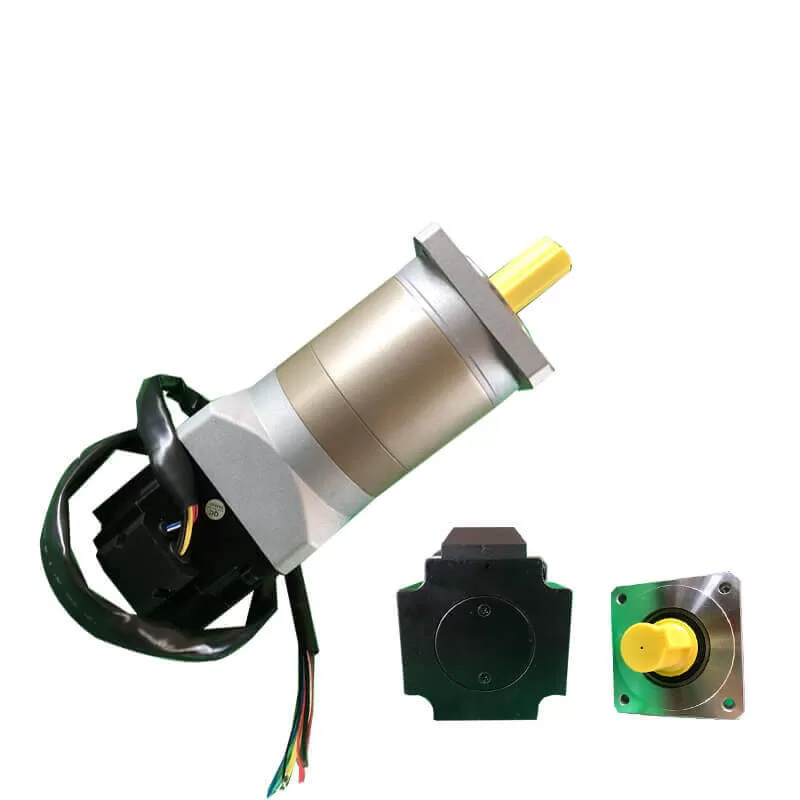
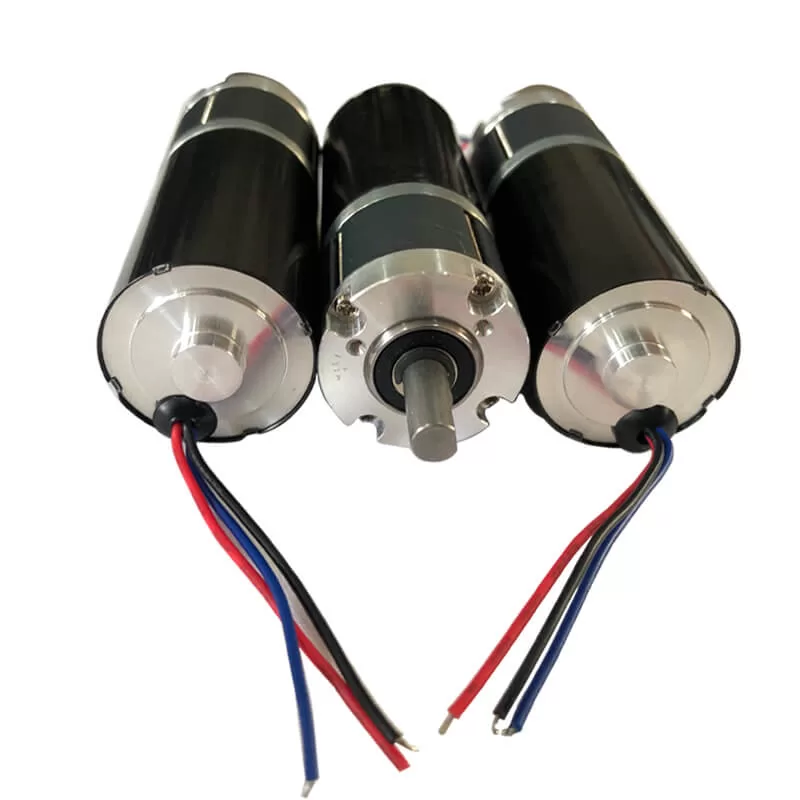
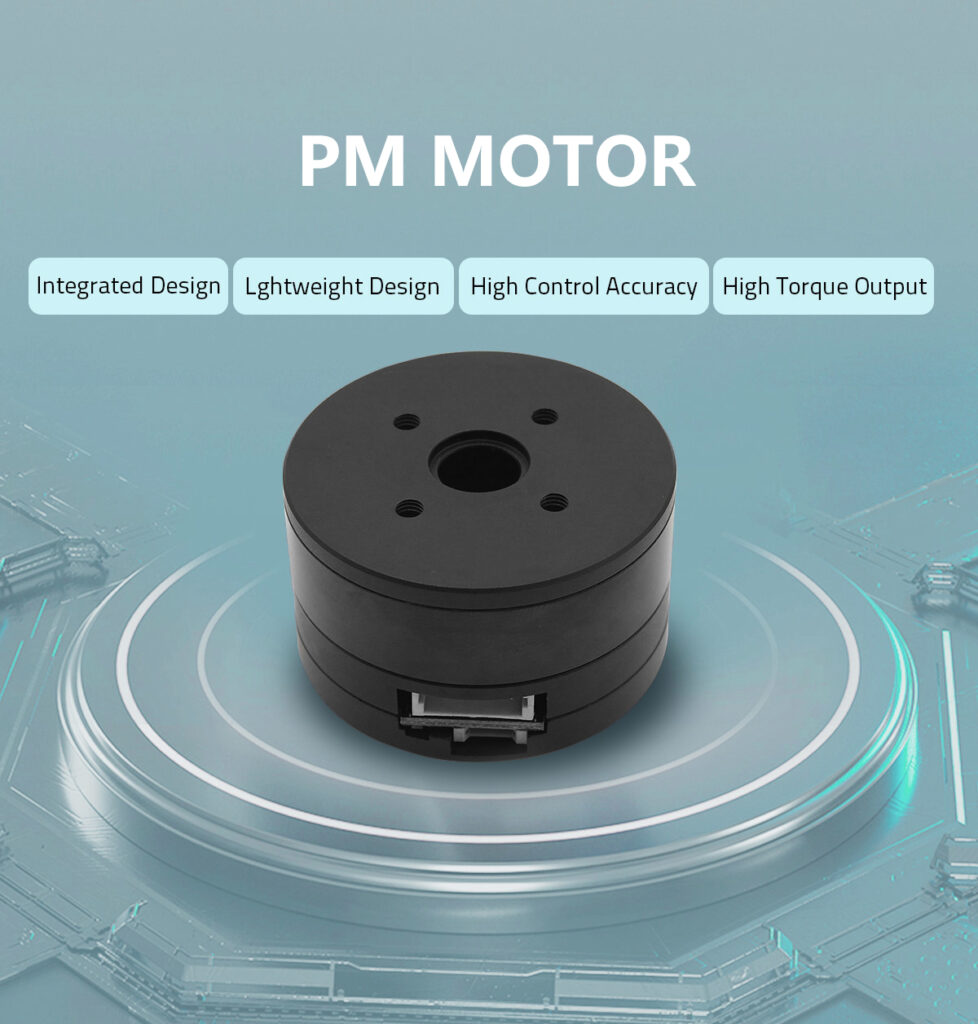
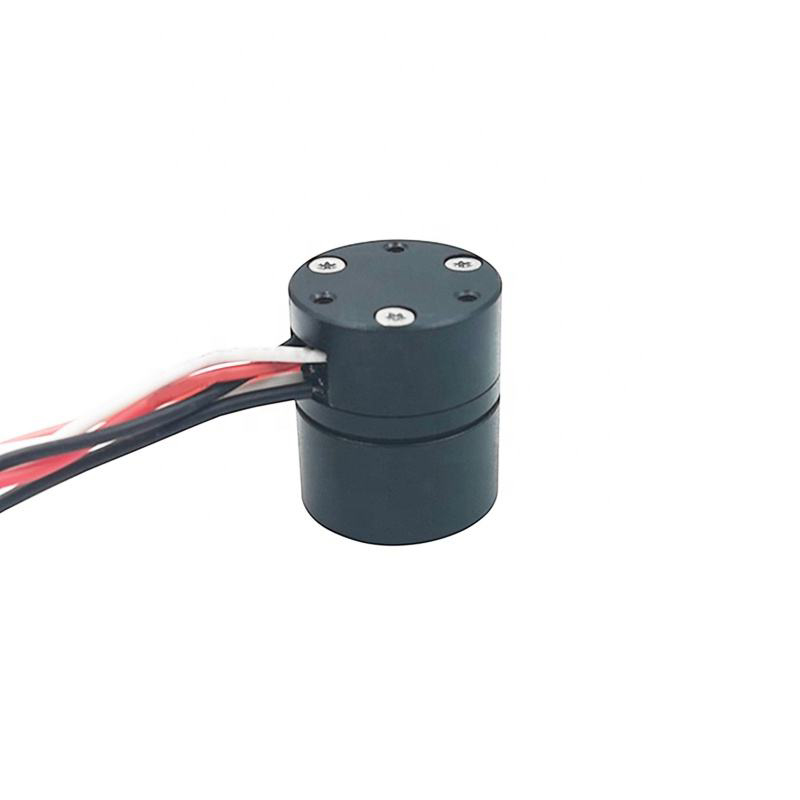
Faradyi Motor supplies permanent-magnet motor solutions for robotics, joint modules, automation, and other precision applications. Explore the Faradyi permanent-magnet motor range or provide your application requirements for an engineering recommendation.
Common Applications of Permanent Magnets
Electric Motors and Generators
Permanent magnets establish magnetic flux in motors and generators used in robotics, industrial automation, vehicles, appliances, power tools, drones, and renewable-energy systems.
Speakers, Headphones, and Microphones
A permanent magnetic field interacts with a current-carrying voice coil to create motion in a speaker. Dynamic microphones use a related electromagnetic principle in reverse to convert motion into an electrical signal.
Sensors and Position Detection
Permanent magnets are used with Hall-effect sensors, reed switches, encoders, and other sensing technologies to detect position, speed, proximity, or rotation without direct mechanical contact.
Holding, Lifting, and Separation
Magnetic fixtures, catches, couplings, separators, and work-holding devices use permanent magnets to provide force without continuous electrical input.
Medical and Scientific Equipment
Permanent magnets can be found in laboratory instruments, motion systems, sensors, and specialized medical equipment. The exact magnet technology used in a medical system depends on its field, uniformity, safety, size, and regulatory requirements.
Consumer Electronics
Smartphones, computers, wearable devices, cameras, and household products may use permanent magnets in speakers, haptic mechanisms, latches, motors, and sensors.
Can a Permanent Magnet Lose Its Magnetism?
Yes. A permanent magnet can partially or completely lose useful magnetization if it operates outside its design limits.
Common causes include:
- Excessive temperature: magnetic properties generally change with temperature, and sufficiently high temperatures can cause irreversible loss.
- Strong opposing magnetic fields: an external reverse field or motor armature reaction can move the magnet toward demagnetization.
- Corrosion: corrosion can physically degrade susceptible magnet materials, particularly if a protective coating is damaged.
- Mechanical shock or damage: many permanent-magnet materials are brittle and may chip or crack when dropped or improperly assembled.
- Poor magnetic-circuit design: magnet geometry, air gaps, neighboring materials, and the operating load line influence stability.
Motor designers should evaluate the magnet’s demagnetization curve at the expected operating temperature and under worst-case current conditions. The magnet grade, motor geometry, cooling system, and controller protection must work together.
How to Select a Permanent Magnet for an Application
The best permanent magnet is not simply the strongest option. Selection should begin with the application’s magnetic, thermal, mechanical, environmental, and commercial requirements.
- Define the required magnetic performance. Establish the working air gap, flux density, force, torque, or sensor switching requirement.
- Determine the complete temperature range. Include normal operation, startup, overload, storage, and nearby heat sources.
- Evaluate demagnetizing fields. Consider opposing fields, short-circuit current, armature reaction, and assembly conditions.
- Select the material family and grade. Compare remanence, coercivity, energy product, temperature coefficients, and cost.
- Choose an appropriate shape. Blocks, rings, arcs, discs, and custom geometries influence the magnetic circuit and manufacturing process.
- Review corrosion protection. Determine whether plating, coating, sealing, or a more corrosion-resistant material is needed.
- Check mechanical integration. Account for brittleness, adhesive bonding, sleeves, rotor speed, centrifugal loading, tolerances, and assembly forces.
- Prototype and validate. Measure performance and temperature in the actual assembly rather than relying only on isolated magnet specifications.
Frequently Asked Questions About Permanent Magnets
What is a permanent magnet in simple terms?
A permanent magnet is a material that keeps producing its own magnetic field without needing electricity. It retains much of its magnetization after the external field used to magnetize it is removed.
Does a permanent magnet require electricity?
No continuous electricity is required to maintain the magnet’s field. A permanent-magnet motor still requires electrical energy to produce controlled mechanical motion; the magnet does not supply free energy.
What is the strongest common permanent-magnet material?
Neodymium-iron-boron generally offers the highest magnetic strength and energy product among widely used commercial permanent-magnet materials at room temperature. The best material for a real application may differ because temperature, corrosion, stability, cost, and mechanical requirements also matter.
How long does a permanent magnet last?
A properly selected magnet can retain useful performance for many years. Its actual life depends on temperature, opposing fields, corrosion, mechanical damage, material grade, and magnetic-circuit design.
Is iron a permanent magnet?
Ordinary iron is ferromagnetic and is strongly attracted to a magnet, but it is typically considered a magnetically soft material because it does not retain strong magnetization as effectively as a purpose-designed permanent-magnet material.
What is the difference between a permanent magnet and a temporary magnet?
A permanent magnet is made to retain magnetization. A temporary or magnetically soft material becomes strongly magnetized in an external field but loses most of that magnetization when the field is removed.
Can permanent magnets generate unlimited energy?
No. A permanent magnet produces a magnetic field, but it is not an unlimited energy source. A motor requires an energy input and obeys conservation of energy.
결론
A permanent magnet is a magnetically hard material that retains a useful magnetic field without continuous electrical power. Its persistent field comes from magnetic-domain alignment that resists being reversed after magnetization.
NdFeB, SmCo, ceramic ferrite, and Alnico magnets offer different combinations of magnetic strength, temperature performance, corrosion resistance, stability, and cost. Selecting the right material requires evaluating the complete operating environment rather than choosing only by magnetic strength.
In electric motors, permanent magnets can support compact size, high torque density, and efficient field production. To discuss a robotics, joint-module, or precision-motion application, explore Faradyi permanent-magnet motors and send the engineering team your voltage, torque, speed, dimensions, duty cycle, temperature range, feedback, and quantity requirements.
Technical References