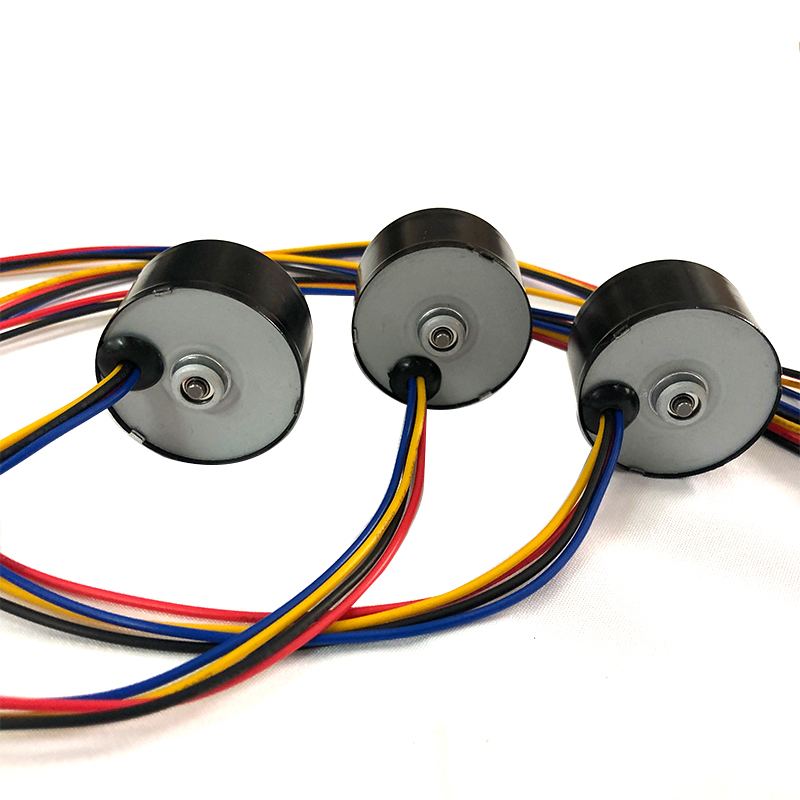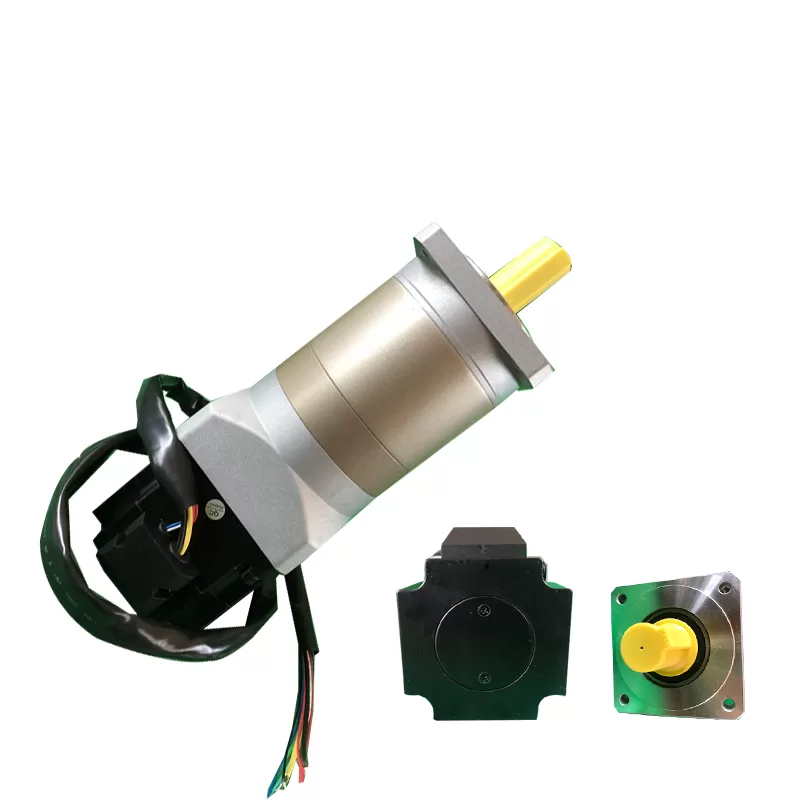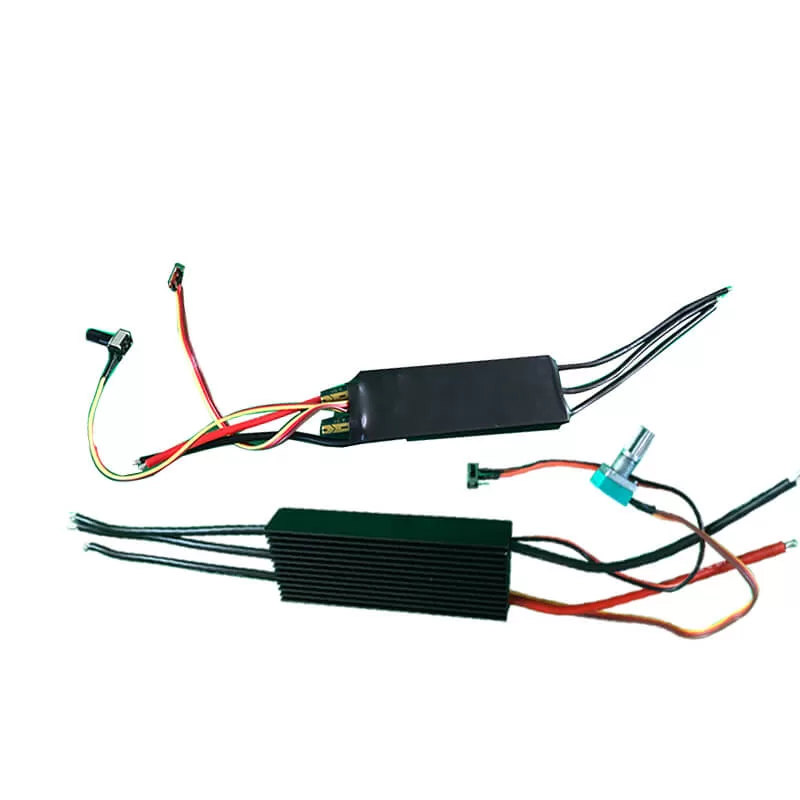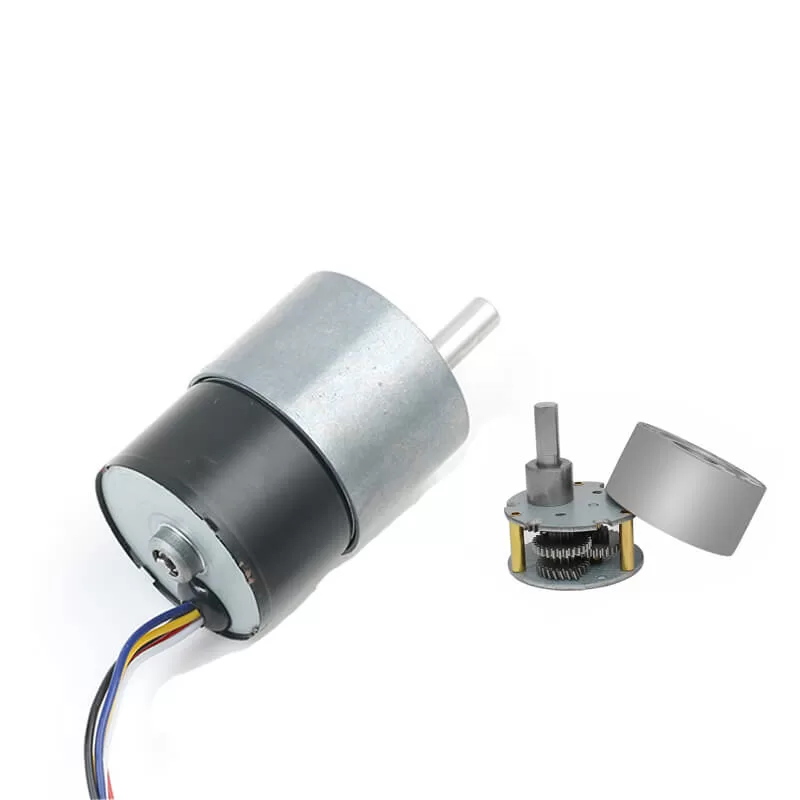
What is Kv in a brushless motor? Kv is the motor’s speed constant, commonly expressed in revolutions per minute per volt (RPM/V). A 1000 Kv motor has an ideal no-load speed tendency of approximately 1,000 RPM for each volt at the motor under the specified measurement convention. Kv does not mean kilovolts, and it is not a direct rating of power, torque, thrust, or efficiency.
What Is Kv in Brushless Motor Specifications?
The letter K indicates a constant, while the subscript v refers to velocity or speed. Product listings often write it as “KV,” but it should not be confused with “kV,” the SI abbreviation for kilovolt.
In motor theory, the speed constant relates rotational speed to back electromotive force (back EMF). In many hobby and propulsion catalogs, Kv is presented as an approximate no-load RPM per volt. Manufacturers may use different test and waveform conventions, so compare values only when their definitions are compatible.
Basic Kv formula
The equation is a first-pass estimate—not a rated operating point. It does not account for winding voltage drop, controller losses, power-source sag, bearing and windage losses, commutation timing, field weakening, or load torque.
Brushless Motor Kv Examples
| Motor Kv | Voltage used for example | Ideal no-load estimate | What it does not prove |
|---|---|---|---|
| 100 Kv | 24 V | 2,400 RPM | Available loaded torque or continuous power |
| 500 Kv | 12 V | 6,000 RPM | Actual shaft speed with a propeller or gearbox |
| 900 Kv | 12 V | 10,800 RPM | Thrust, efficiency, or a safe propeller size |
| 1500 Kv | 12 V | 18,000 RPM | Maximum mechanical RPM or ESC suitability |
On a phone, swipe the table horizontally to view every column.
Use the actual voltage available at the motor or controller for engineering calculations. Battery “nominal voltage,” fully charged voltage, and loaded voltage can differ. Confirm the manufacturer’s Kv definition and operating limits.
Why Actual Loaded RPM Is Lower
A rotating permanent-magnet motor generates back EMF that opposes the applied voltage. To produce torque, current must flow through winding resistance and inductance, which requires voltage headroom. As mechanical load increases, the motor draws more phase current and speed settles below the ideal Kv calculation.
Real speed is affected by:
- winding resistance and copper temperature;
- ESC voltage drop and modulation limits;
- battery or power-supply sag;
- cable and connector resistance;
- bearing friction, windage, and seal drag;
- propeller, fan, pump, gearbox, wheel, or machine load;
- commutation timing and control method;
- current, voltage, speed, and thermal limiting.
For a real design, use a manufacturer torque-speed curve, efficiency map, or application-specific test table rather than multiplying Kv by voltage and treating the result as guaranteed operating speed.
How Kv Relates to Torque Constant
The torque constant, commonly written as Kt, relates motor torque to current. For an ideal permanent-magnet motor, speed constant and torque constant are inversely related: a winding with lower Kv generally has a higher torque constant, while a winding with higher Kv generally requires more current to produce the same torque.
That relationship does not mean that any low-Kv motor produces more maximum torque than any high-Kv motor. Maximum and continuous torque also depend on motor diameter and length, magnetic circuit, air gap, copper fill, winding resistance, saturation, phase-current limit, cooling, temperature, bearings, and duty cycle.
Does Lower Kv Mean More Torque?
A precise answer is: lower Kv usually means more torque per ampere for compatible windings of the same motor design, but Kv alone does not define maximum torque.
Suppose the same motor geometry is offered with two winding options. The lower-Kv winding normally uses more turns of finer wire, giving a higher torque constant and requiring more voltage for the same speed. The higher-Kv winding normally uses fewer turns of thicker wire, giving a lower torque constant and requiring more current for the same torque. The two variants can have similar underlying electromagnetic capability but suit different voltage and current constraints.
Comparing unrelated motors by Kv alone is unreliable. A large high-Kv motor may produce far more torque than a small low-Kv motor because its active material and thermal capacity are different.
Does Higher Kv Mean More Power?
No. Kv indicates speed tendency per volt. Mechanical power depends on torque and angular speed:
A high-Kv motor may reach high speed, but usable power is limited by current, winding temperature, iron loss, bearing speed, rotor strength, magnets, ESC, cooling, and load. Likewise, a low-Kv motor is not automatically a high-power motor. Use continuous and peak power limits with their test conditions.
How Motor Design Determines Kv
Kv is influenced by the motor’s winding and magnetic design, including:
- number of winding turns;
- winding connection and distribution;
- magnetic flux density and magnet geometry;
- stator and rotor dimensions;
- air-gap geometry;
- pole and slot arrangement;
- the manufacturer’s measurement convention.
Changing winding turns can create multiple Kv versions of the same motor frame. Kv does not describe build quality, balance, cogging torque, bearing life, or thermal performance.
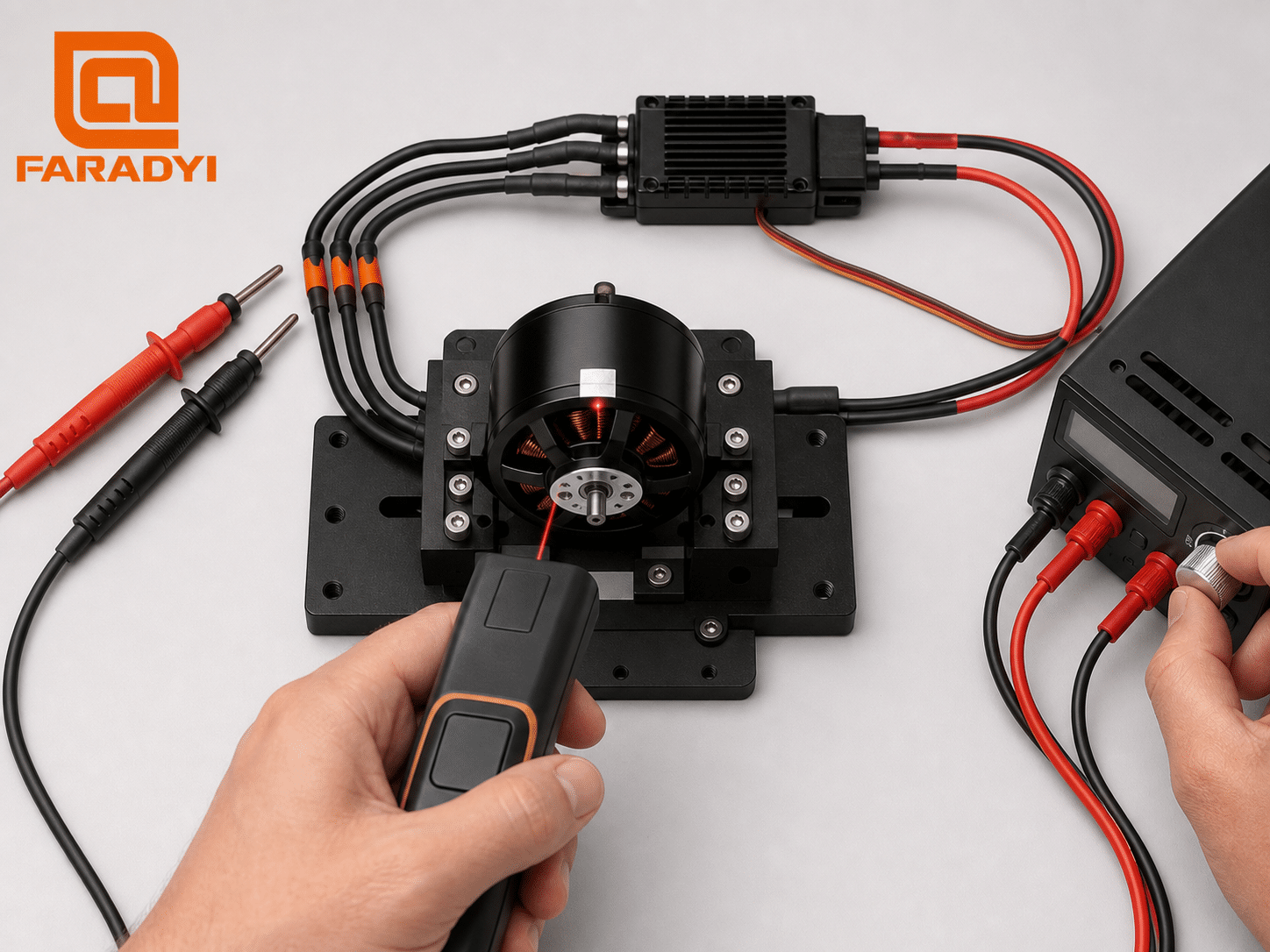
How to Measure Brushless Motor Kv Safely
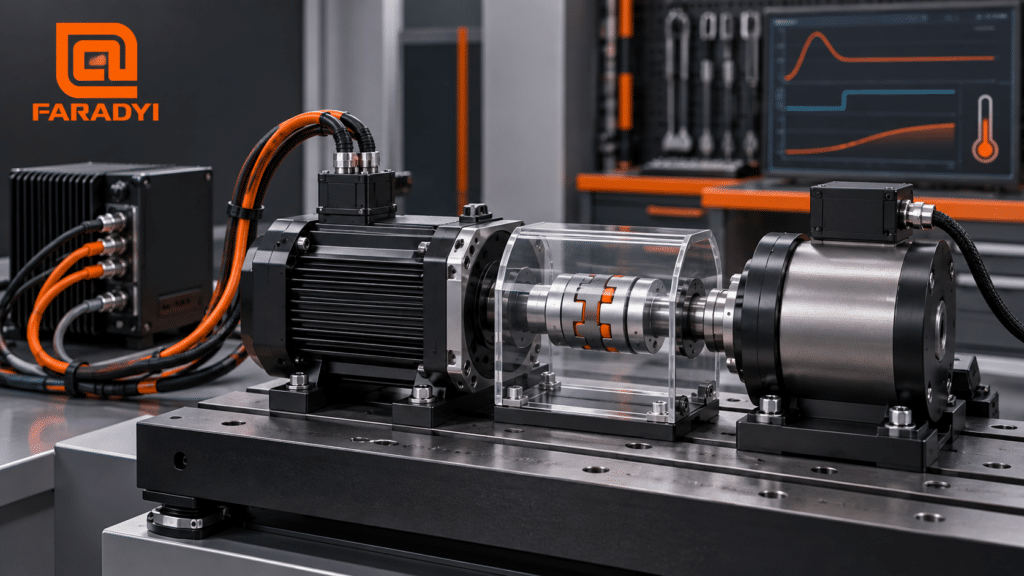
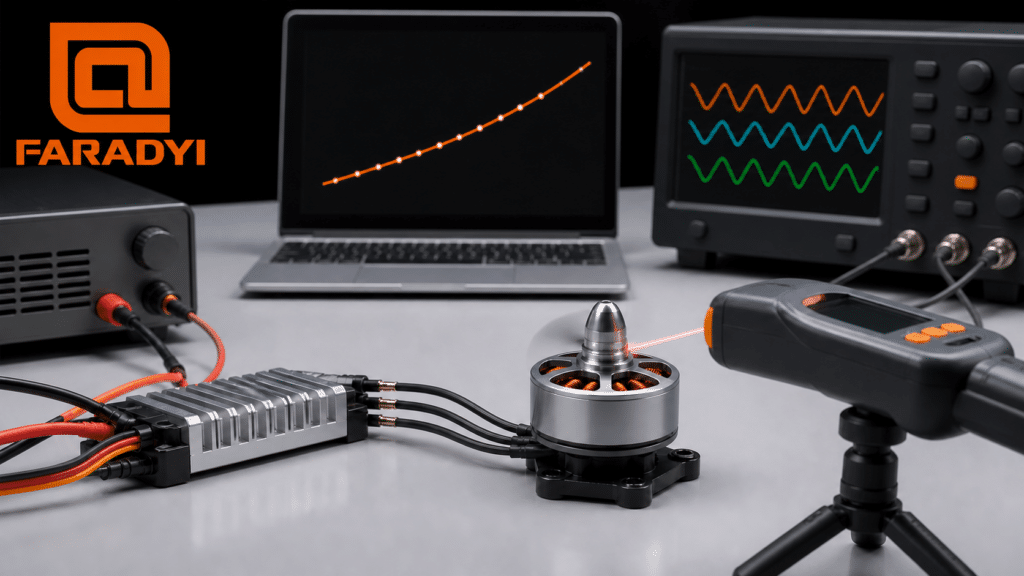
Direct measurement requires controlled equipment and a documented method. The simplest practical concept is to operate the unloaded motor at a safe steady point, measure mechanical shaft speed and actual voltage using compatible definitions, then calculate:
However, controller modulation, no-load current, voltage drop, timing, and waveform definitions affect the result. A laboratory back-drive test that measures back EMF can characterize the speed constant more directly, but it should be performed by qualified personnel using the manufacturer’s electrical convention.
Safe measurement checklist
- Secure the motor to a rigid test fixture.
- Remove propellers, wheels, couplings, gears, and other rotating loads.
- Confirm the motor, ESC, power source, connectors, and instruments are compatible.
- Use a current-limited supply and begin at a low voltage and command.
- Keep personnel and loose items away from the rotor.
- Measure shaft RPM with a suitable noncontact tachometer.
- Measure voltage at the defined point and record the controller setup.
- Repeat at several safe steady voltages and compare the slope rather than relying on one reading.
- Stop if vibration, noise, current, or temperature becomes abnormal.
High-Kv vs Low-Kv Brushless Motors
| Characteristic | Higher Kv tendency | Lower Kv tendency | Important limitation |
|---|---|---|---|
| No-load speed at the same voltage | Higher | Lower | Loaded RPM depends on the system |
| Torque constant for comparable windings | Lower torque per compatible ampere convention | Higher torque per compatible ampere convention | Maximum torque still depends on size, current, and cooling |
| Voltage needed for the same speed | Lower | Higher | Controller modulation and back EMF need margin |
| Common propulsion pairing | Smaller, faster propeller or fan | Larger, slower propeller or fan | Use tested load data; never choose a propeller from Kv alone |
| Industrial drive implication | Can suit low-voltage high-speed operation | Can suit higher-voltage lower-speed operation | Gear ratio, current, thermal limits, and controller matter |
On a phone, swipe the table horizontally to view every column.
How to Choose the Right Kv
- Start with required loaded speed. Define the shaft speed range, not only a no-load target.
- Define the supply. Record nominal, fully charged, minimum loaded, and maximum regenerative bus voltage where applicable.
- Estimate a Kv range. Divide the desired no-load ceiling by available voltage, then allow appropriate controller and load margin.
- Calculate torque and current. Use the motion or propulsion load, duty cycle, torque constant, phase-current convention, and controller limit.
- Check torque-speed and thermal data. Confirm continuous and peak operating points with the intended cooling.
- Match the controller. Verify voltage, continuous and peak phase current, electrical-RPM capability, sensors, commutation method, braking, and protection.
- Match the mechanical load. Validate propeller, fan, pump, wheel, gearbox, or machine load with test data.
- Check maximum mechanical speed. Kv multiplied by the highest possible bus voltage must not drive the rotor or bearings beyond their limits.
- Test the complete system. Measure loaded RPM, current, temperature, efficiency, vibration, and control behavior.
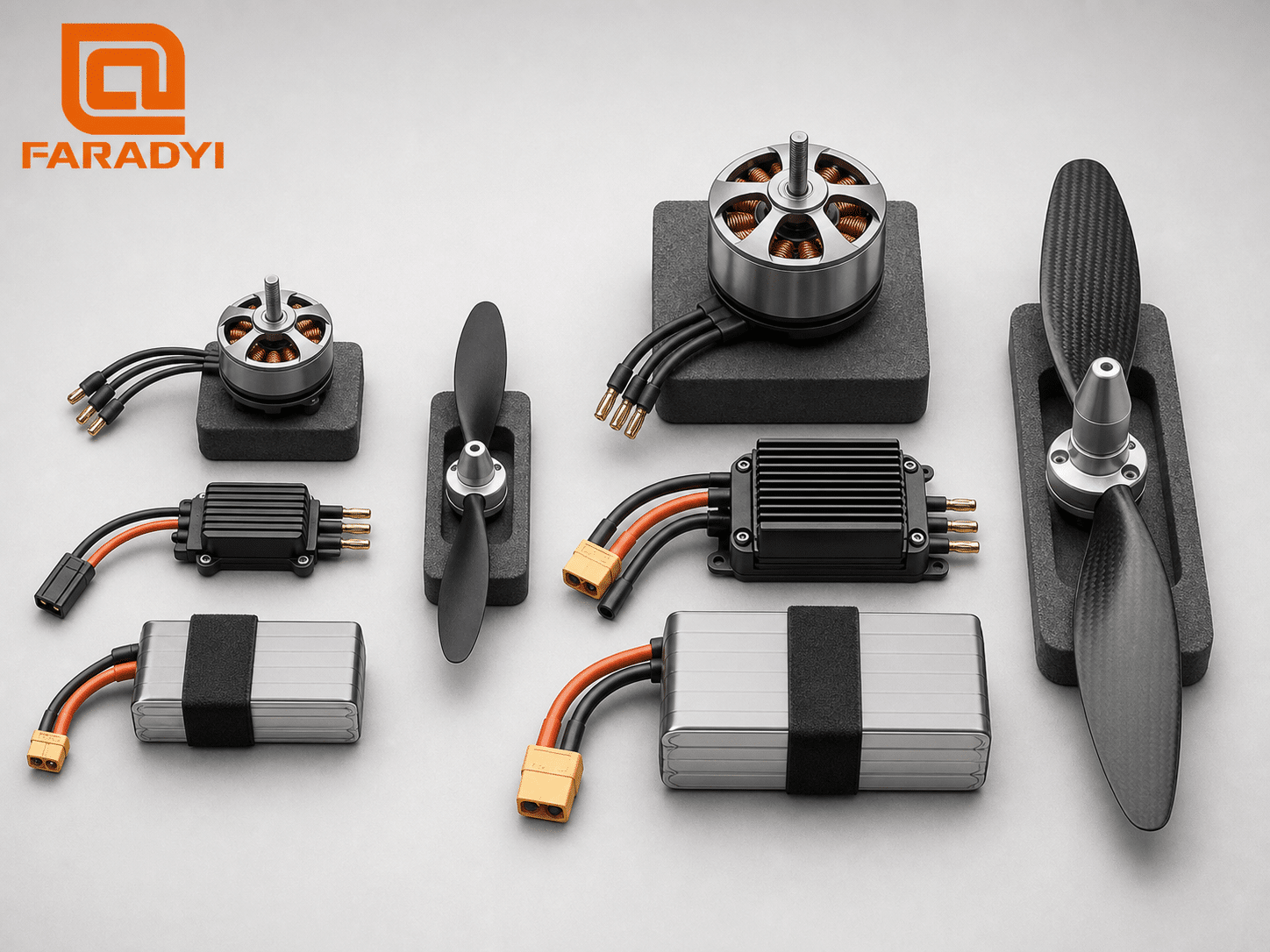
Kv Selection for Common Applications
Drones and propeller systems
Higher-Kv motors are commonly paired with smaller propellers and lower voltage, while lower-Kv motors are commonly paired with larger propellers and higher voltage. This is only a starting tendency. Select from manufacturer thrust tables that use the exact motor, propeller, battery voltage, ESC, and test conditions. An oversized propeller can overload the motor and ESC even if the no-load RPM calculation looks reasonable.
Fans, blowers, and pumps
Aerodynamic and hydraulic loads can rise rapidly with speed. Match Kv to the required operating curve, controller, inlet/outlet conditions, and continuous cooling. Do not use free-air speed to predict installed performance.
Robotics and industrial motion
Start with loaded speed, continuous and peak torque, inertia, gear ratio, supply voltage, feedback, and duty cycle. A gearbox can move the motor into a more efficient speed range, but its efficiency, backlash, reflected inertia, and output limits must be included.
Electric vehicles and wheels
Wheel diameter, gear ratio, grade, vehicle mass, acceleration, thermal duty, battery sag, field weakening, and regenerative braking all affect selection. Kv alone cannot predict road speed or climbing performance.
Common Kv Selection Mistakes
- Reading Kv as kilovolts
- Treating Kv × voltage as guaranteed loaded RPM
- Assuming higher Kv means higher power
- Assuming lower Kv always means higher maximum torque
- Comparing Kv values measured with different conventions
- Ignoring fully charged battery voltage and supply sag
- Ignoring the ESC’s phase current and electrical-RPM limit
- Selecting a propeller or fan from Kv alone
- Ignoring maximum rotor speed, bearing limits, and cooling
- Using no-load current as evidence of loaded efficiency
What to Provide for a Brushless Motor Recommendation
To receive a useful motor recommendation or quotation, provide:
- available voltage range, including maximum and minimum loaded voltage;
- required loaded speed range;
- continuous and peak torque, thrust, flow, pressure, or other load data;
- complete duty cycle and operating time;
- ESC or controller voltage, phase-current, sensor, and communication requirements;
- propeller, fan, pump, wheel, gearbox, or mechanism details;
- motor diameter, length, shaft, mounting, weight, and cable constraints;
- ambient temperature, altitude, airflow, vibration, dust, and moisture;
- feedback, brake, acoustic, and electromagnetic-compatibility requirements;
- prototype and annual quantities.
Faradyi Motor offers a broad range of brushless motors across different constructions and applications. Use the category as a starting point, then confirm Kv, torque-speed curves, current, cooling, controller compatibility, and load-specific test data for the exact model.
Need Help Choosing Brushless Motor Kv?
Send Faradyi Motor your voltage, loaded speed, torque or thrust, duty cycle, ESC, mechanical load, installation space, environment, and quantity.
Frequently Asked Questions
What is Kv in a brushless motor?
Kv is the motor speed constant, commonly expressed as approximate no-load RPM per volt. It describes speed tendency, not kilovolts, power, torque, or efficiency.
What does a 1000 Kv motor mean?
It means an ideal no-load speed tendency of about 1,000 RPM per volt under the specified convention. At 12 V, the simple estimate is 12,000 RPM, but loaded speed will be lower.
Is a higher-Kv brushless motor faster?
At the same voltage and under comparable no-load conditions, a higher-Kv motor tends to spin faster. Its safe loaded speed still depends on current, controller, load, and mechanical limits.
Does lower Kv provide more torque?
For compatible windings of the same motor design, lower Kv generally means a higher torque constant, or more torque per ampere. Maximum torque depends on motor size, current, saturation, cooling, and duty cycle.
Can I calculate torque directly from Kv?
Kv and Kt are inversely related, but numerical conversion factors vary with phase, line, peak, RMS, and waveform conventions. Use the manufacturer’s stated torque constant and current definition whenever possible.
Does Kv determine the correct propeller?
No. Kv is one input. Propeller choice also depends on motor size, voltage, ESC current, desired thrust, aircraft, cooling, and verified motor-propeller test data.
Does changing voltage change the motor’s Kv?
For normal operation, Kv is primarily a motor design constant. Changing voltage changes the ideal speed estimate, not the underlying Kv. Temperature, magnetic saturation, controller settings, and measurement method can affect observed results.
Why is my motor slower than Kv multiplied by battery voltage?
The simple calculation is an ideal no-load estimate. Load torque, winding voltage drop, battery sag, ESC losses, friction, timing, current limits, and thermal limits reduce actual speed.
Conclusion
Understanding what is Kv in brushless motor selection begins with one definition: Kv is speed per volt, usually stated as no-load RPM/V. Use Kv to estimate a speed range, then qualify the complete system with torque constant, current, voltage, power, thermal limits, controller capability, maximum mechanical speed, and real load data. Explore Faradyi’s brushless motor range and provide your application requirements for a model-specific review.
Technical References