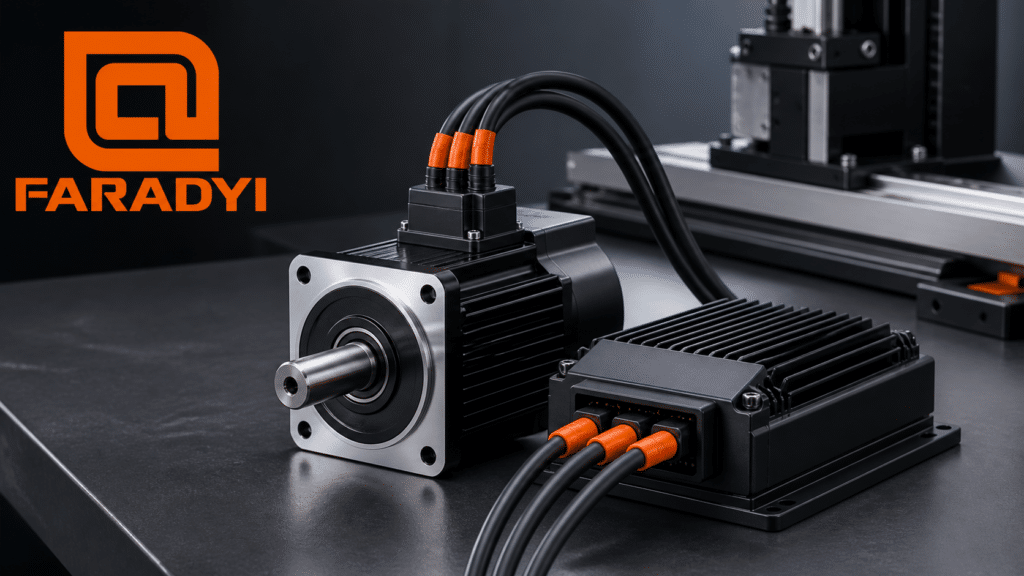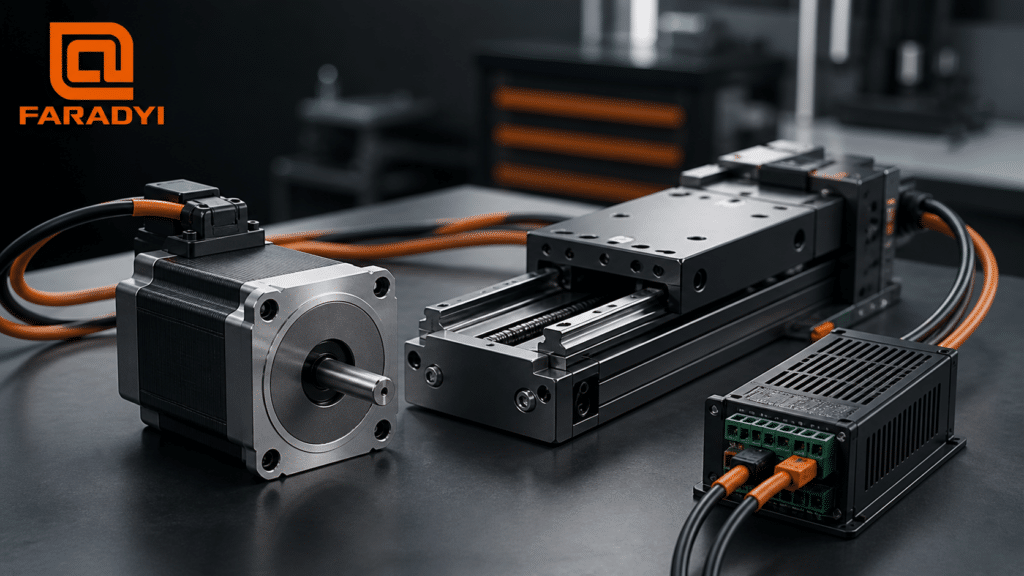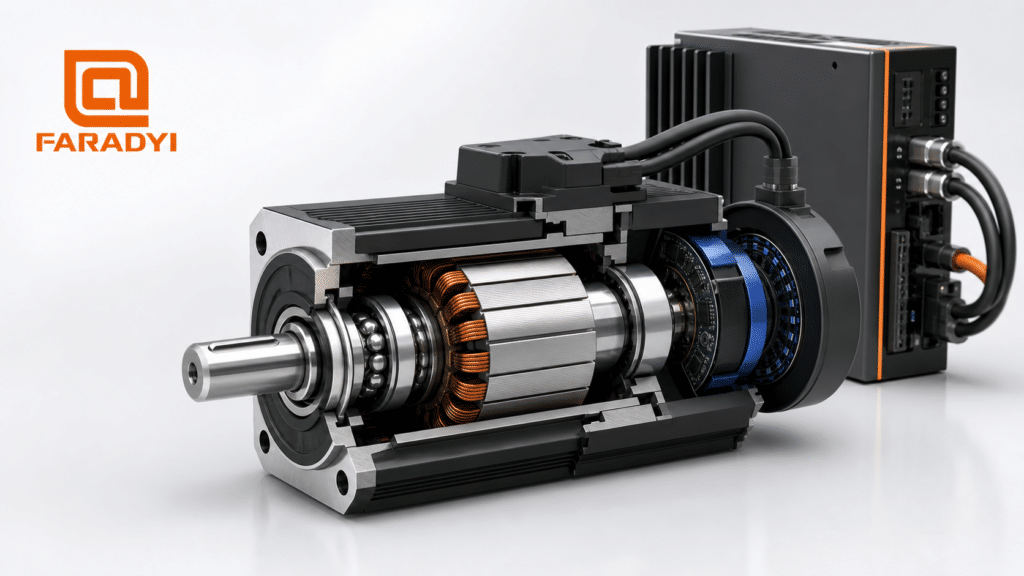
A servo brushless motor system combines a brushless motor, position feedback, and a compatible servo drive to control motion in a closed loop. The drive compares the commanded position, speed, or torque with measured feedback and continuously adjusts current to reduce the error.
This architecture provides precise, responsive motion without the brushes and mechanical commutator used in a brushed DC motor. Brushless servo systems are widely used in robotics, industrial automation, CNC equipment, packaging machinery, laboratory instruments, and other applications requiring controlled position, velocity, or torque.
However, a brushless DC motor is not automatically a servo motor. “Brushless” describes motor construction and electronic commutation. “Servo” describes how a complete motion system uses feedback and control. Motor, encoder, drive, power supply, mechanics, and tuning must work together for the system to perform correctly.
What Is a Servo Brushless Motor?
A servo brushless motor is the motor component of a closed-loop servo system. In many compact DC-powered systems, the motor is a three-phase brushless DC (BLDC) permanent-magnet motor. In industrial systems, similar permanent-magnet synchronous motors may be described as brushless AC, PMAC, or AC servo motors.
The terminology can overlap because BLDC and permanent-magnet synchronous motors share important construction principles. They generally use a permanent-magnet rotor and wound stator, while electronic power switching creates a rotating magnetic field. Differences may include winding design, back-EMF waveform, commutation method, feedback, and drive control strategy.
The defining servo function is closed-loop control. A feedback device measures actual motion, and the servo drive uses that information to adjust motor current so the axis follows the command.
Is Every BLDC Motor a Servo Motor?
No. A BLDC motor can operate in applications such as fans, pumps, propellers, and spindles without precision position control. It may use Hall sensors or sensorless back-EMF detection only for electronic commutation.
To operate as a precision servo axis, the system usually needs:
- A motor suitable for the required motion and thermal load
- A compatible feedback device, such as an encoder or resolver
- A servo drive that supports the motor and feedback signals
- A motion command or controller
- Proper control-loop tuning
- Mechanical transmission and load characteristics within the system’s capabilities
Adding an encoder alone does not guarantee servo performance. The drive must be able to use the feedback, commutate the motor correctly, regulate current, and close the required speed or position loops.
How Does a Brushless Servo Motor Work?
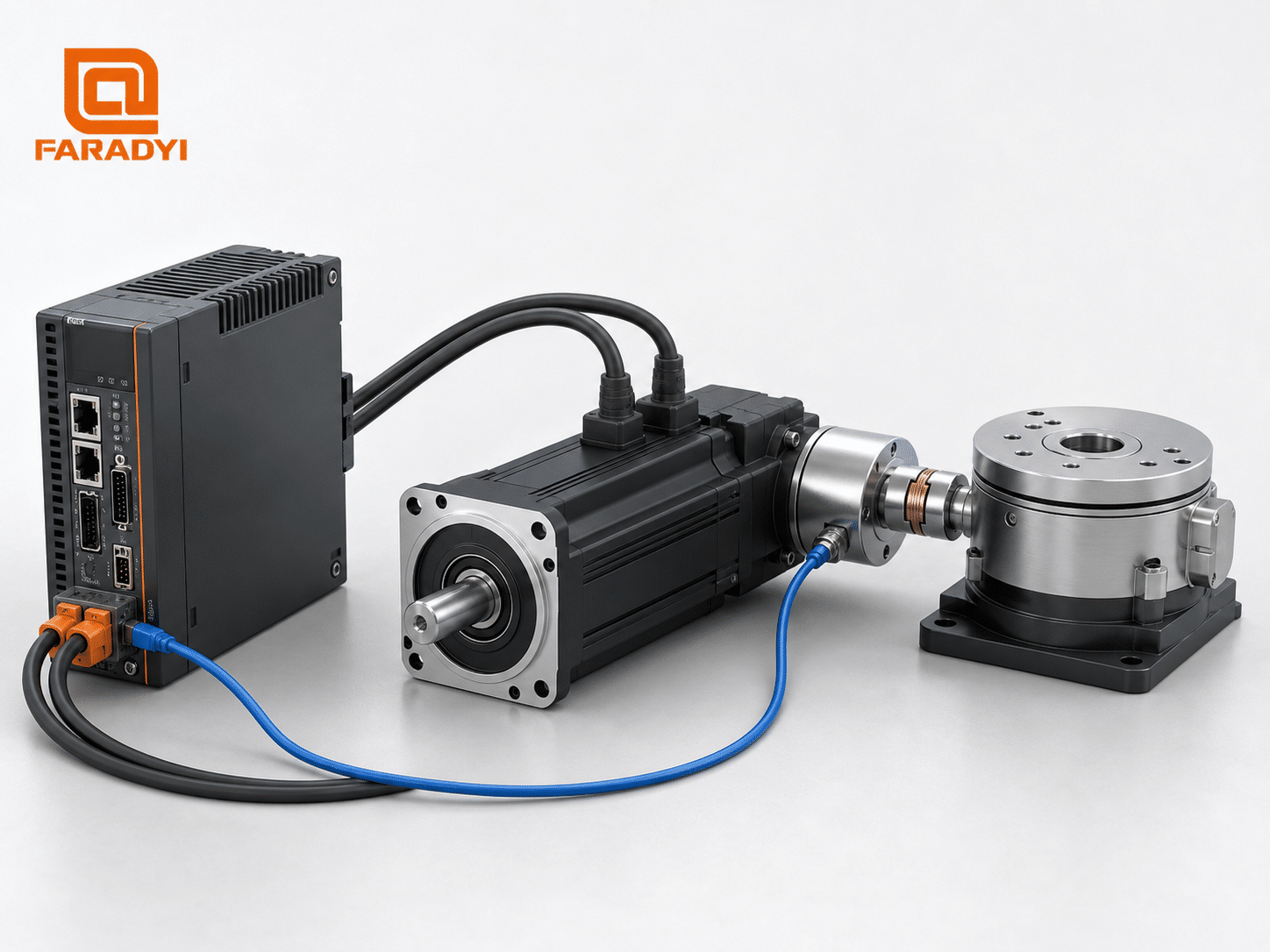
A brushless servo system converts a motion command into controlled mechanical output through a continuous feedback process.
- The controller sends a command. The command may specify position, velocity, torque, or a motion trajectory.
- The feedback device measures actual motion. An encoder or resolver reports rotor position and may also support speed estimation.
- The servo drive calculates the error. It compares the commanded state with measured feedback.
- The drive regulates phase current. Power electronics switch current through the stator windings to produce the required magnetic field and torque.
- The permanent-magnet rotor turns. The rotor follows the rotating stator field and drives the shaft and load.
- The process repeats continuously. The drive keeps correcting for load changes, friction, and other disturbances within the system’s limits.
Many servo drives use nested or cascaded control loops. A fast current loop regulates torque-producing current. A speed loop commands the current loop, and a position loop may command the speed loop. The exact structure depends on the drive and control mode.
Main Parts of a Servo Brushless Motor System
Brushless Permanent-Magnet Motor
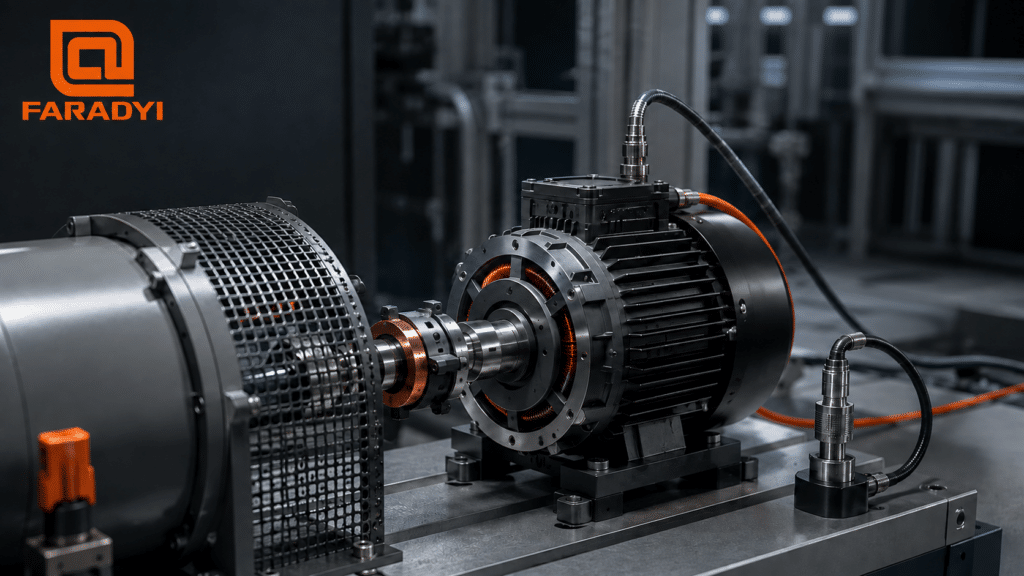
The motor typically contains a permanent-magnet rotor, wound stator, shaft, bearings, housing, and electrical connections. Because commutation is electronic, there are no brushes rubbing against a mechanical commutator.
Motor geometry affects torque constant, back EMF, inductance, inertia, cogging torque, speed capability, thermal behavior, and mechanical integration.
Feedback Device
The feedback device measures rotor or output position. Common options include incremental encoders, absolute encoders, magnetic encoders, optical encoders, and resolvers.
Feedback resolution is not the same as final positioning accuracy. Accuracy also depends on encoder error, mechanical stiffness, backlash, coupling, bearings, load disturbance, controller tuning, and where the feedback is measured.
Servo Drive
The servo drive contains power electronics and control algorithms. It interprets commands, reads feedback, performs electronic commutation, regulates phase current, manages control loops, and protects the system against supported fault conditions.
The drive must match the motor’s voltage, continuous and peak current, electrical parameters, feedback format, commutation method, and application requirements.
Motion Controller
A separate motion controller, PLC, robot controller, CNC controller, or embedded computer may generate position and velocity commands. In simpler systems, some control functions may be integrated into the servo drive.
Power Supply and Cabling
The supply must support normal operation, acceleration, peak current, and regenerative energy. Proper motor, feedback, grounding, shielding, and communication cabling helps reduce electrical noise and feedback errors.
Mechanical Load and Transmission
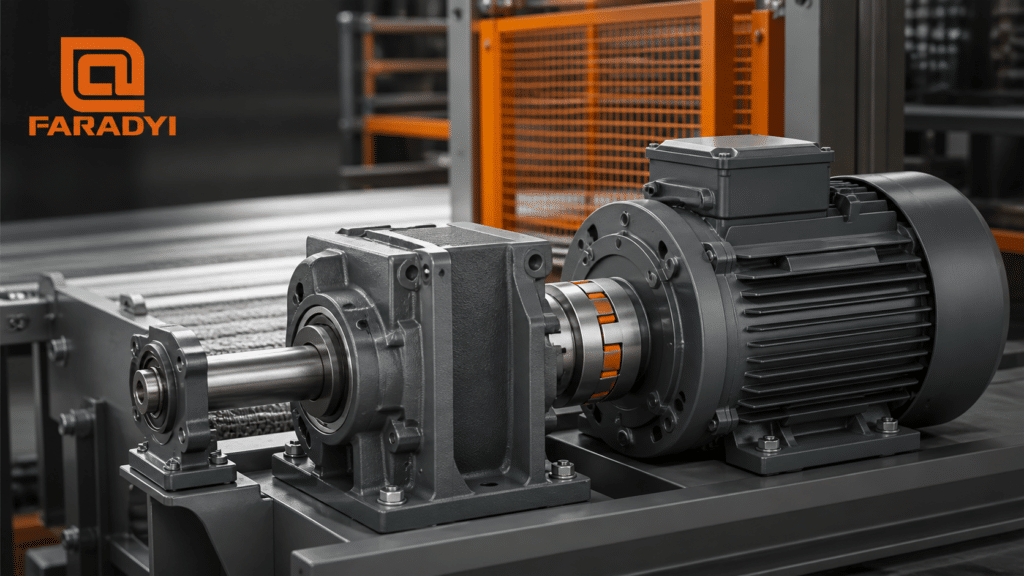
Couplings, gearboxes, belts, screws, and the driven load affect inertia, stiffness, backlash, resonance, torque demand, and accuracy. Servo performance cannot be evaluated from the motor specification alone.
Hall Sensors vs. Encoders in a Brushless Servo System
Hall sensors and encoders both provide rotor information, but they normally serve different purposes.
| Characteristic | Hall sensors | Encoder or resolver |
|---|---|---|
| Typical purpose | Coarse rotor-position information for commutation | Higher-detail position and speed feedback |
| Position detail | Relatively coarse | Depends on device resolution and accuracy |
| Precision positioning | Usually insufficient alone | Commonly used for closed-loop servo positioning |
| Absolute position | Only coarse electrical sector information | Available with suitable absolute-feedback devices |
| Environmental fit | Simple and robust in many motor designs | Device-specific; resolvers suit demanding environments |
General comparison only. Capabilities depend on the specific sensor and drive. On a phone, swipe horizontally to view the complete table.
Hall sensors should not generally be described as load sensors. Motor torque may be estimated from current, while direct load or force measurement requires an appropriate sensor and control architecture.
BLDC Motor vs. Brushless Servo Motor
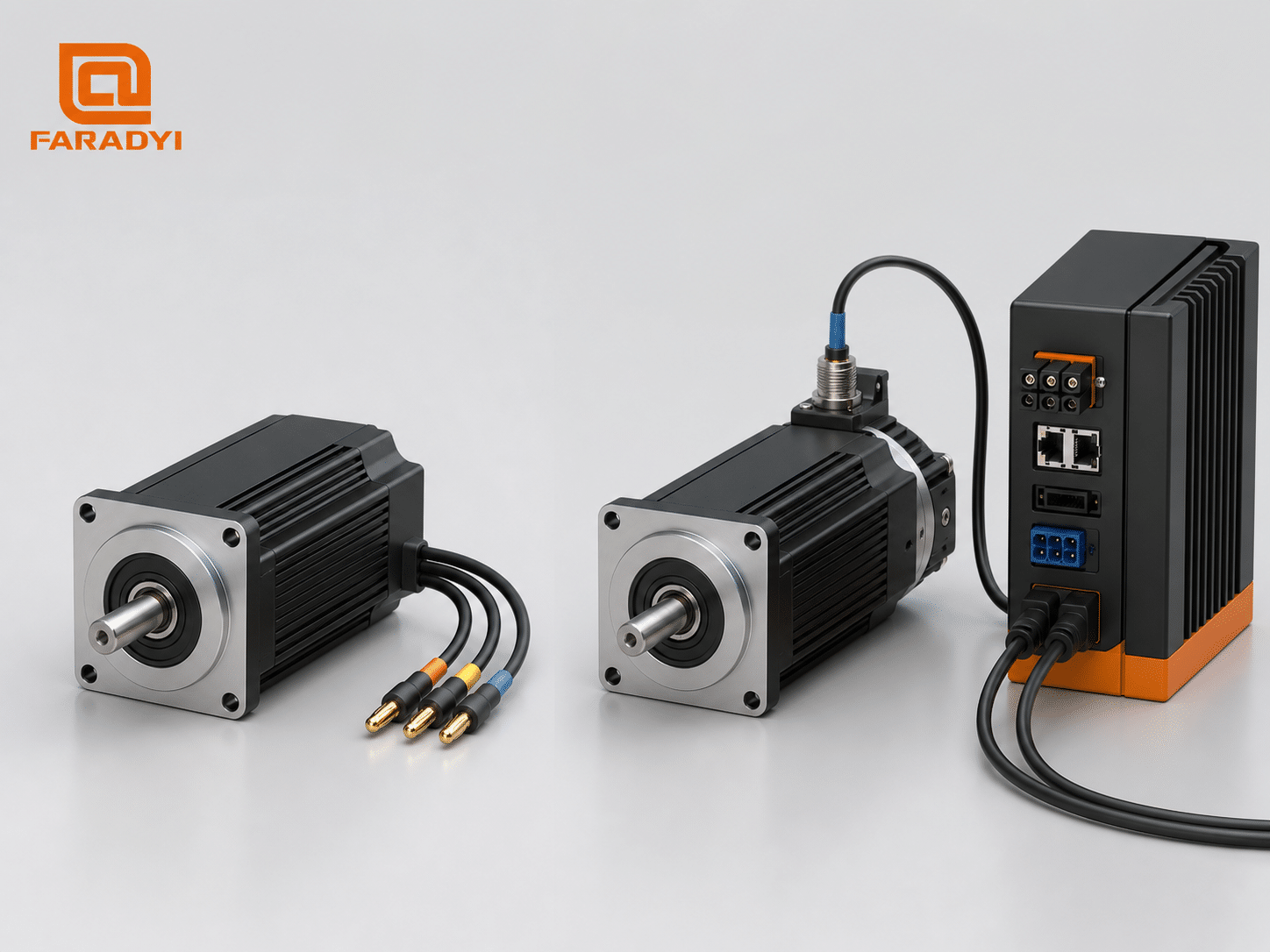
The hardware may look similar, but the intended system behavior is different.
| Characteristic | General BLDC motor system | Brushless servo system |
|---|---|---|
| Primary objective | Efficient continuous rotation or basic speed control | Controlled position, speed, or torque response |
| Feedback | Sensorless or Hall-based operation may be sufficient | Usually encoder or resolver feedback |
| Drive | BLDC controller or ESC | Servo drive with closed-loop control |
| Positioning | Not necessarily supported | Core function when configured for position control |
| Commissioning | Often simpler | Requires parameter matching and loop tuning |
| Typical applications | Fans, pumps, blowers, propellers and spindles | Robotics, CNC, packaging and precision automation |
The dividing line is functional rather than absolute. Some BLDC drives support closed-loop speed control, and some brushless motors can become part of a servo system when correctly matched with feedback and a servo drive.
Brushless DC Servo vs. AC Servo
“BLDC servo” and “AC servo” are sometimes treated as separate categories, but industry terminology is not perfectly consistent. Both commonly use three-phase permanent-magnet synchronous motor construction and electronic drives.
Traditional BLDC terminology often refers to trapezoidal back EMF and six-step commutation. AC servo or permanent-magnet synchronous motor terminology often refers to sinusoidal current control and sinusoidal back EMF. Modern drives may use field-oriented control with brushless permanent-magnet motors, making simple labels less important than the actual motor and drive specifications.
When comparing systems, verify:
- Supported commutation and current-control method
- Motor voltage, current, resistance, and inductance
- Feedback type and interface
- Continuous and peak torque-speed curves
- Control modes and communication protocol
- Required smoothness, bandwidth, and positioning performance
Advantages of Servo Brushless Motors
Precise Closed-Loop Motion
Feedback allows the drive to detect error and correct motion within the system’s mechanical and control limits. This supports accurate positioning, regulated speed, and controlled torque.
Fast Dynamic Response
A properly sized and tuned system can respond quickly to command changes and load disturbances. Performance depends on motor inertia, load inertia, current capability, control bandwidth, rigidity, and resonance.
Low Mechanical Maintenance
Electronic commutation eliminates brush and commutator wear. Bearings, seals, cables, feedback devices, gearboxes, and other mechanical components still have finite service lives.
Strong Torque-to-Size Performance
Permanent-magnet brushless designs can deliver useful torque from a compact motor. Continuous torque remains thermally limited, while peak torque is available only for specified durations and conditions.
Broad Speed Range
Closed-loop control can maintain useful motion across a wide speed range. Very low speed, zero-speed holding, and high-speed operation depend on feedback, drive algorithms, motor design, and cooling.
Limitations and Design Tradeoffs
Higher System Complexity
A complete servo axis requires a compatible motor, feedback device, drive, power supply, cabling, controller, and correctly configured software.
Tuning Requirements
Poor tuning can cause overshoot, vibration, noise, slow response, or instability. Flexible couplings, belt compliance, gearbox backlash, and structural resonance can limit achievable control bandwidth.
Cost
Feedback, drive electronics, connectors, shielded cables, commissioning, and engineering time can make a servo system more expensive than a basic BLDC or open-loop stepper solution.
Thermal Limits
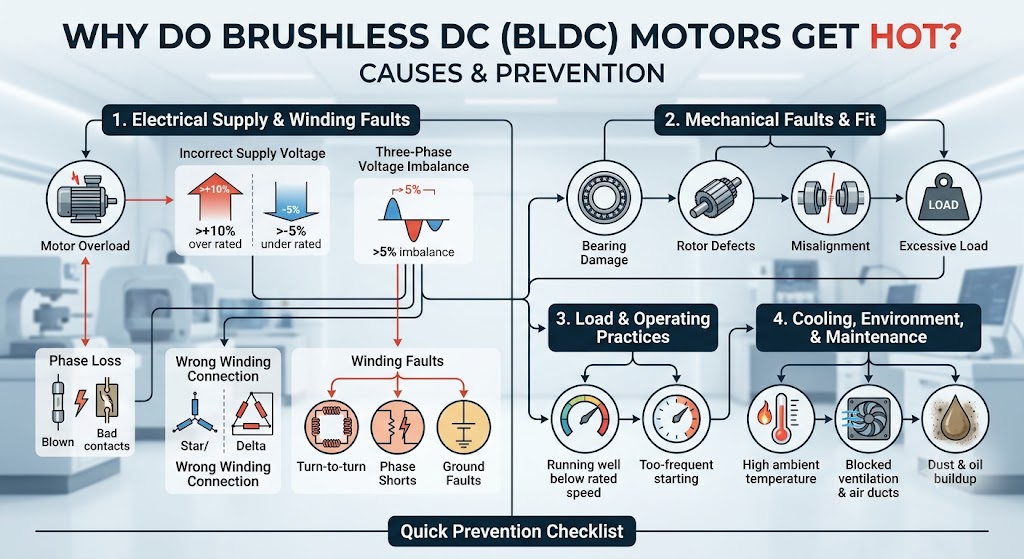
High continuous torque and repeated acceleration generate winding and drive heat. Motor ratings must be evaluated at the actual ambient temperature, mounting condition, airflow, duty cycle, and speed.
Electrical Noise and Integration
Fast switching currents can introduce electromagnetic interference. Cable routing, grounding, shielding, filters, connectors, and cabinet design matter, particularly around encoders and communication lines.
일반적인 응용 프로그램
Industrial Robotics
Brushless servo systems control robot joints, grippers, rotary axes, and linear actuators that need coordinated position, speed, and torque.
CNC and Machine Tools
Servo axes position machine slides, spindles, tool changers, and feed systems. Final accuracy also depends on mechanics, feedback placement, calibration, thermal effects, and machine structure.
Packaging and Production Equipment
Fast response and electronic synchronization support indexing, registration, filling, sealing, labeling, and cut-to-length processes.
Medical and Laboratory Equipment
Servo brushless motors may be used in pumps, sample handling, imaging mechanisms, and robotic equipment. Medical suitability depends on complete device design, risk management, validation, and regulatory requirements.
Camera, Gimbal, and Optical Systems
Low-noise brushless operation and feedback control can support stabilization, scanning, lens positioning, and pan-tilt mechanisms.
Automated Guided Vehicles and Mobile Robots
Closed-loop wheel drives can regulate speed and position under changing load. Gear ratio, battery voltage, regenerative behavior, braking, traction, and thermal duty must be evaluated together.
How to Select a Servo Brushless Motor System
- Define the motion profile. Specify travel, position, speed, acceleration, deceleration, dwell time, and cycle rate.
- Calculate load torque. Include friction, gravity, process forces, transmission losses, and external disturbances.
- Calculate acceleration torque. Use total reflected inertia and required angular acceleration.
- Separate continuous and peak requirements. Confirm RMS torque, peak-torque duration, and drive-current limits.
- Check the torque-speed curve. Verify that the motor can deliver required torque at the actual operating speed and bus voltage.
- Evaluate inertia matching. Consider load-to-motor inertia ratio, mechanical stiffness, gearing, and required response.
- Select feedback. Match resolution, accuracy, absolute-position needs, environment, interface, and startup behavior.
- Match the servo drive. Confirm voltage, current, commutation, electrical parameters, feedback, control mode, and communications.
- Review the mechanical interface. Check shaft, flange, bearings, coupling, gearbox, radial and axial loads, and mounting envelope.
- Complete a thermal check. Evaluate winding temperature, drive temperature, ambient conditions, airflow, housing contact, and duty cycle.
- Plan safety functions. Determine requirements for braking, safe torque off, limit switches, emergency stops, and applicable machine standards.
- Prototype and tune the real axis. Test temperature, tracking error, settling time, overshoot, noise, vibration, and fault behavior with the actual load.
Information to Provide for a Motor Recommendation
To help Faradyi evaluate a brushless motor for a servo application, provide:
- DC bus or supply voltage
- Required continuous and peak torque
- Peak-torque duration
- Maximum and normal operating speed
- Motion profile and duty cycle
- Load and transmission inertia
- Positioning accuracy and repeatability target
- Encoder or resolver preference
- Servo-drive model or interface requirements
- Shaft, flange, diameter, and length limits
- Gearbox, brake, or holding requirements
- Ambient temperature and enclosure requirements
- Expected annual quantity
Faradyi supplies brushless motor options for a range of motion applications. Not every general-purpose BLDC motor is configured as a complete servo system, so feedback, drive compatibility, and the load profile should be reviewed during selection. Explore Faradyi brushless DC motors and send your application parameters to request an engineering recommendation.
자주 묻는 질문
What is a servo brushless motor?
It is a brushless motor used in a closed-loop servo system with feedback and a compatible drive. The system regulates position, speed, or torque by continually comparing the command with measured motion.
Is a brushless motor the same as a servo motor?
No. Brushless describes how the motor is constructed and commutated. Servo describes closed-loop control of motion. A brushless motor can be used without servo control, or it can become part of a servo system.
Does a brushless servo motor need an encoder?
Precision servo positioning normally uses an encoder, resolver, or another suitable feedback device. Some speed-control applications use Hall sensors or sensorless estimation, but these approaches do not provide the same position information as a precision encoder.
Can Hall sensors replace an encoder?
Hall sensors can provide coarse rotor-position information for commutation, but they are usually insufficient for high-resolution positioning. Whether they are adequate depends on the required control performance.
Can any BLDC motor be converted into a servo motor?
Not automatically. The motor must be compatible with the feedback device and servo drive, and its electrical, thermal, mechanical, and torque-speed characteristics must suit the application.
How is servo motor torque controlled?
In many systems, the drive regulates phase current because motor torque is related to current. Actual output torque still depends on the motor torque constant, current measurement, magnetic conditions, losses, and controller limits.
Can a brushless servo hold position at zero speed?
A correctly configured servo can produce holding torque at zero speed within its continuous current and thermal limits. A mechanical brake is still needed when the load must remain held after power loss or when required by safety analysis.
Is a servo brushless motor better than a stepper motor?
Neither is universally better. Brushless servos are often preferred for high speed, fast acceleration, and disturbance rejection. Steppers may be simpler and more economical for suitable lower-speed positioning tasks. Selection depends on the complete motion profile and performance requirements.
결론
A servo brushless motor system combines a brushless permanent-magnet motor, feedback device, servo drive, power supply, controls, and mechanical load. Its defining feature is the closed control loop—not merely the absence of brushes.
This architecture can deliver precise position, speed, and torque-related control with fast response and low mechanical maintenance. Its performance depends on correct sizing, compatible feedback and drive electronics, thermal design, mechanics, cabling, safety provisions, and control-loop tuning.
When selecting a system, evaluate the complete motion profile, continuous and peak torque, speed, inertia, feedback, drive compatibility, accuracy, duty cycle, environment, and mechanical interface. Review Faradyi brushless DC motors and provide your application data so the engineering team can assess a suitable motor and servo integration approach.
Technical References