Why Do Electric Motors Get Hot?
Electric motors get hot because no motor converts all electrical input into mechanical output. In a brushless DC motor, electrical resistance, magnetic changes in the core, bearings, air drag, rotor losses, and the electronic drive all convert part of the input power into heat. A warm housing can therefore be normal; overheating means a component exceeds its specified temperature limit or the temperature is rising abnormally for the same operating condition.
Do not judge safety by touch. Housing temperature can differ substantially from winding, bearing, magnet, and controller temperatures. When evaluating brushless DC motors, compare measurements with the exact motor and drive documentation, using the specified sensor location and operating conditions.
Where BLDC Motor Heat Comes From
Copper loss
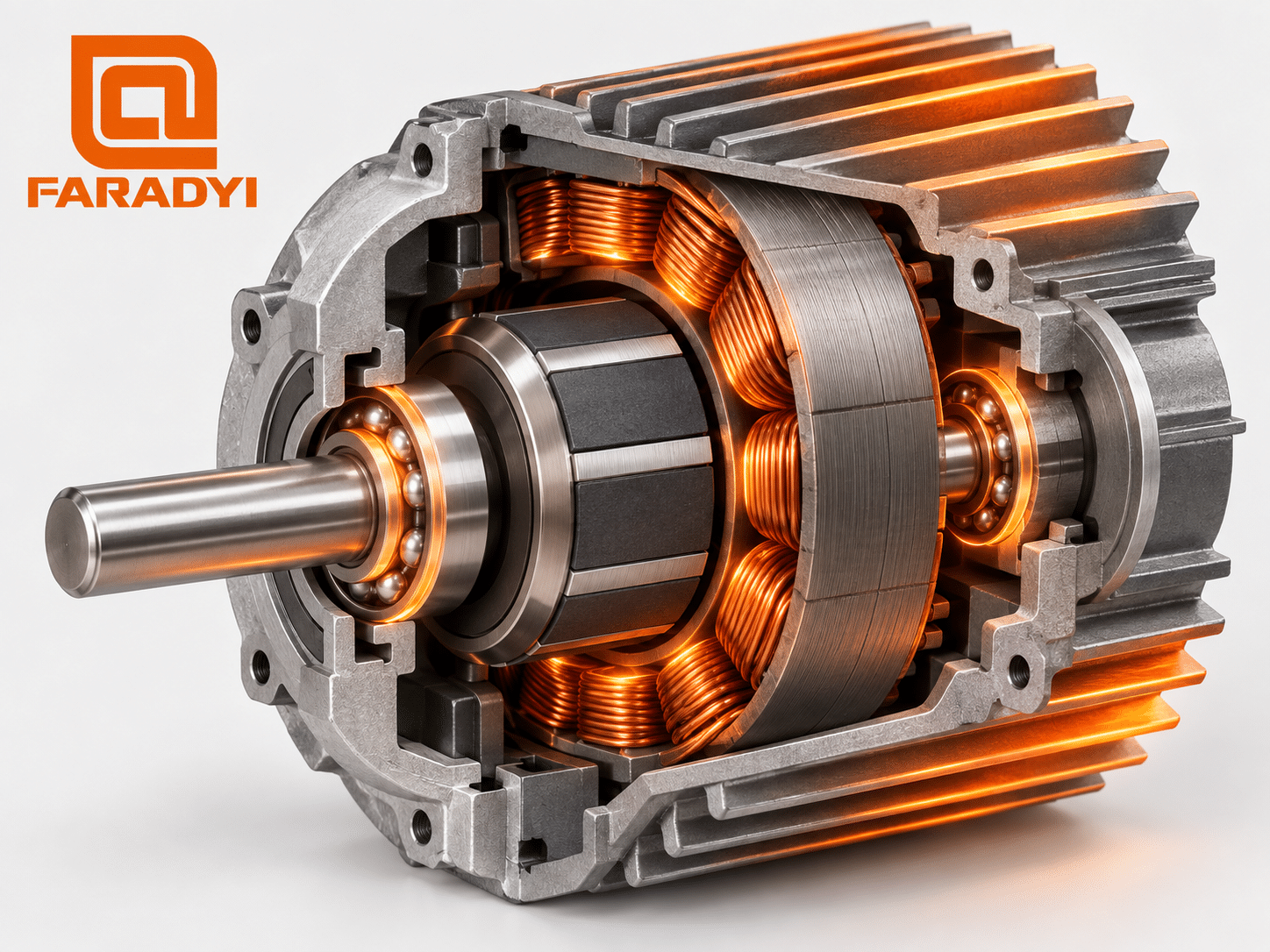
Current flowing through winding resistance produces heat approximately proportional to I²R. This is why a modest increase in torque-producing current can create a much larger increase in winding loss. Resistance also rises as copper gets hotter, reinforcing temperature rise.
Core and rotor loss
Changing magnetic fields create hysteresis and eddy-current losses in the laminated stator. Frequency, flux density, speed, PWM behavior, lamination material, and motor geometry affect these losses. Permanent magnets and conductive rotor parts can also experience eddy-current heating.
Mechanical and controller loss
Bearings, seals, windage, misalignment, and the driven mechanism create friction. The inverter produces conduction and switching losses. A hot controller, connector, or cable may therefore indicate a system issue rather than heat generated only inside the motor.
Common Causes of BLDC Motor Overheating
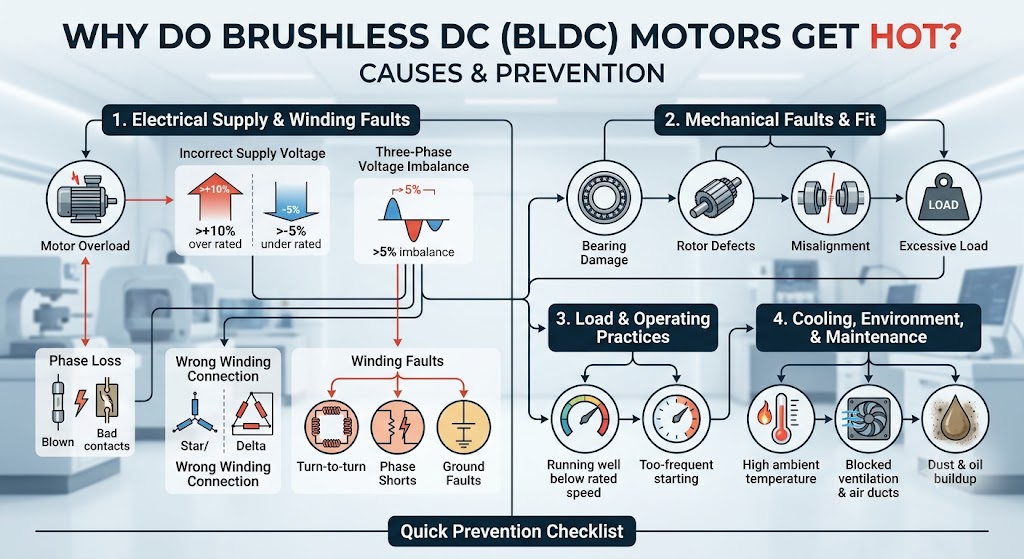
- Mechanical overload: the machine demands more continuous or peak torque than the motor can provide thermally.
- Excessive phase current: current limits, torque commands, startup boost, or controller tuning exceed the motor requirement.
- Frequent starts, reversals, or stalls: high current persists while average mechanical output remains low.
- Restricted cooling: blocked fins, poor airflow, enclosure recirculation, or an inadequate mounting surface prevents heat rejection.
- High ambient temperature: reduces the temperature margin available to the motor and controller.
- Low-speed high-torque operation: produces copper loss while shaft-driven airflow may be limited.
- Incorrect commutation: Hall sequence, phase order, sensor alignment, timing, or control parameters cause inefficient current.
- Bearing, coupling, or load problems: damaged bearings, misalignment, belt tension, rubbing, or a binding mechanism increases torque demand.
- Power and connection problems: incorrect DC-bus voltage, loose/high-resistance connections, undersized cables, or phase imbalance raises loss.
- Motor-drive mismatch: incompatible voltage, current, speed, winding, feedback, PWM, or control method creates excess heat.
Symptom-to-Cause Troubleshooting Table
| Observation | Possible causes | First checks |
|---|---|---|
| Whole housing unusually hot | Overload, high current, poor cooling, high ambient | Load, RMS phase current, airflow, ambient, duty |
| Bearing end hottest | Bearing damage, excessive shaft load, misalignment | Vibration, shaft load, coupling, belt tension |
| Connector or cable hotspot | Loose contact, damaged crimp, undersized conductor | De-energize; inspect and measure connection quality |
| Hot mainly at low speed | High torque current with reduced self-cooling | Torque profile, current, cooling method, duty |
| Heat after controller change | Wrong current limit, timing, feedback, PWM, or phase mapping | Restore validated settings and verify compatibility |
Phone users: swipe horizontally to view all table columns.
How to Diagnose an Overheating Motor Safely
- Stop for dangerous symptoms: smoke, odor, discoloration, damaged insulation, abnormal noise, repeated protection trips, or rapidly rising temperature require shutdown and qualified inspection.
- Document the operating point: ambient, bus voltage, speed, load, duty cycle, acceleration, phase current, controller settings, and measurement location.
- Compare with specifications: check motor, sensor, controller, cable, bearing-load, and cooling limits.
- Separate motor from load where safe: determine whether drag comes from the motor or driven mechanism.
- Inspect cooling and mechanics: fins, airflow, enclosure, mounting contact, bearings, coupling, belt tension, alignment, and rubbing.
- Verify electrical operation: phase resistance balance using the manufacturer’s method, connections, Hall/encoder sequence, phase order, current waveform, current limit, and commutation timing.
- Trend temperatures: compare identical locations under repeatable conditions. Thermal imaging finds patterns but does not replace internal sensor data.
How to Prevent Excess Motor Heat
- Size continuous torque from the real duty cycle, not peak torque alone.
- Use a compatible controller and validated phase-current limits.
- Apply sensible acceleration, deceleration, and stall protection.
- Provide adequate airflow, heat-sinking, enclosure ventilation, or forced cooling.
- Keep fins and air paths clean and maintain the rated ambient range.
- Align shafts and keep radial/axial loads within motor limits.
- Monitor winding, case, bearing, and controller temperature where risk justifies it.
- Revalidate thermal performance after changing load, gearing, controller, supply, enclosure, or cycle time.
Frequently Asked Questions
Is it normal for a brushless DC motor to feel hot?
It can be. Heat conducted to the housing is part of the cooling path. Only model-specific limits and correctly located measurements determine whether the temperature is acceptable.
Can low voltage make a BLDC motor hot?
Possibly, depending on the controller. If the system tries to maintain torque or power, lower bus voltage may lead to higher current, saturation of the control command, or longer high-current operation. Diagnose the controller and load together.
Why does the motor overheat at low speed?
High torque still requires phase current, while shaft-driven cooling may decline. Copper loss can remain high even when mechanical speed and output power are low.
Will a bigger controller solve overheating?
No. A controller with more current capability can damage an undersized motor if limits are wrong. Match the drive and protection settings to the motor and application.
Select a BLDC Motor for the Thermal Duty
Understanding why electric motors get hot helps prevent premature insulation, bearing, magnet, and electronics failure. When comparing Faradyi brushless DC motors, provide supply voltage, continuous and peak torque, loaded speed, duty cycle, starts and stalls, controller, phase current, mounting, shaft load, ambient temperature, enclosure, cooling, feedback, size constraints, and quantity.
Technical References